The Layers Beneath Your Code: Who Owns Them in 2026?

From Copilot suggestions to Lambda runtimes, modern development rests on infrastructure that is being quietly re-sorted—and Europe's sovereignty push is only one force in that reordering.
By Oliver Weber
Cloud Infrastructure Strategist
Last Updated: June 16, 2026
Reading Time: 9 min read
Over the past two years, technology media has been fascinated by the topic of “data sovereignty”—where your code is stored, which country your servers reside in, and whether everything complies with GDPR. In January 2026, AWS launched its fully sovereign European Sovereign Cloud in Europe, backed by a €7.8 billion investment and operated exclusively by EU residents. In April, Microsoft announced that Azure Local would support offline AI workloads. In June, the European Commission introduced the Cloud and AI Development Act (CADA), aiming to triple Europe's data center capacity within five years.
These developments sound significant. But for someone who writes code every day, the real question is not “Where is the data?” It is who can change the rules without your knowledge.
Your code may live in Frankfurt, but the people deciding the lifespan of your runtime are in Seattle. Your code snippets may never leave the EU, but the people determining Copilot's behavior are in Redmond. Your open-source tools may reside entirely on your local machine, but the people deciding the license terms are in San Francisco. This is the real meaning of the layers beneath your code—not physical location, but ownership of control.
Layer One: The Data Layer — Where Do Your Code Fragments Go?
Developers generate enormous amounts of data every day: code commits, debugging logs, error traces, and AI assistant interactions. Where that data is stored is only the most visible question. The deeper issue is: who can access it, and who can change the rules governing that access?
In 2026, Microsoft expanded its EU Data Boundary initiative to include Copilot-related processing, stating that code snippets from EU users would not be used for model training. However, KuppingerCole noted in its report Microsoft's Sovereign Cloud in 2026 that Microsoft, as a U.S.-headquartered company, remains subject to extraterritorial legal frameworks such as the CLOUD Act. Data localization reduces risk, but it does not eliminate the legal basis for access. In other words, the written rules in Europe may appear identical, but the ultimate authority to interpret those rules does not reside in Europe.
A more subtle example involves GitHub. In late 2024, GitHub updated its terms of service regarding the use of code-scanning data, allowing broader security analysis. Most developers never read the announcement email. Only after discussions surfaced on Hacker News did people notice that dependency graph information from certain private repositories had been incorporated into public security alerts. The data never left GitHub—but the rules governing its use changed.
Layer Two: The Operations Layer — Who Manages Your Control Plane?
This is the layer most easily obscured by sovereignty-cloud marketing.
AWS ESC promises that all operations personnel are EU residents. The S3NS joint venture with Proximus emphasizes that services are operated by a European company. It sounds as if your cloud is being managed by Europeans. Yet the true source of operational control lies in the control plane—who owns the service architecture, who pushes updates, and who can silently adjust API rate limits behind the scenes.
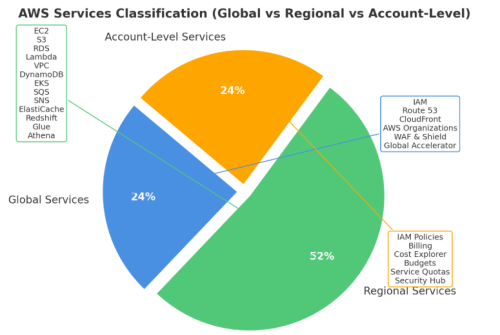
AWS Services Classification
AWS ESC maintains complete API compatibility with global AWS regions. That means migrations are frictionless. It also means that when AWS changes Lambda concurrency limits or alters S3 billing granularity, ESC customers and Ohio-region customers receive those changes simultaneously.
Azure Local can run offline, but lifecycle management and update distribution still depend on Microsoft's global delivery pipelines.
In the European Commission's first sovereign-cloud procurement evaluation in April 2026, the Proximus/S3NS model received a SEAL-2 rating (data sovereignty level), while OVHcloud, STACKIT, and Scaleway received SEAL-3 ratings (digital resilience level), largely because their underlying technologies are European-controlled and less vulnerable to supply-chain disruptions originating outside the EU.
The distinction highlights an important reality: operational sovereignty and the nationality of operations staff are not the same thing.
Layer Three: The Technology Layer — Runtimes, APIs, and Licenses
This is often the most painful layer for developers because rule changes here directly disrupt workflows.
In 2023, HashiCorp moved Terraform from the MPL license to the Business Source License (BSL). Overnight, the infrastructure-as-code ecosystem split, and OpenTofu emerged. The code remained available, but the legal conditions governing its use changed. Developers were not consulted. The rules were changed unilaterally.
Cloud runtime deprecations are even more frequent examples of rule changes. AWS's Lambda Runtime Deprecation Policy (2026) states that developers will receive advance notice before runtime versions are retired. Yet the length of the notification period, the migration window, and the security patch strategy for older versions are all determined by AWS alone. The deprecation of Python 3.8 runtimes in 2025 caused numerous CI/CD pipelines to fail unexpectedly.
Then there are API behavior changes. In 2024, OpenAI adjusted the default behavior of GPT-4's temperature settings without prior announcement, causing many automation workflows that relied on specific output characteristics to break. This was not a pricing change. It was a change in technical behavior rules.
Layer Four: The Infrastructure Layer — Chips, Power, and Physical Reality
This is the deepest layer, and often the one developers pay the least attention to.
AWS ESC servers may sit in Frankfurt, but Graviton processors are designed in California. If geopolitical developments restrict access to advanced chip technology, the expansion capacity of Frankfurt-based data centers could be affected even though the physical infrastructure remains on European soil.
In 2021, a fire at OVHcloud's Strasbourg data center destroyed multiple facilities and disrupted services across Europe. The incident reminded the industry that infrastructure sovereignty is not merely about where servers are located. It is also about who determines power redundancy standards, who maintains fire-suppression systems, and who designs the underlying chip architectures.
Unilateral changes at this level can be even more consequential than software license changes.
Why These Layers Are Being Reordered
The redistribution of control across these four layers is not being driven by a single force. The changes unfolding in 2026 are the result of four competing pressures, with Europe representing only one of them.
Governments Want More Control
Europe is not alone. The United States has the CLOUD Act. China has its Data Security Law. India, Indonesia, Vietnam, and many others are advancing data-localization requirements.
The European Commission's proposed CADA framework, introduced in June 2026, seeks to establish a unified sovereignty evaluation system for cloud infrastructure while tripling EU data-center capacity. Yet governments primarily control procurement rules and legal access mechanisms—not your runtime versions.
As one German developer put it:
"Our CIO received a SEAL compliance checklist, but there wasn't a single question asking whether our Lambda runtimes could be deprecated unilaterally."
Cloud Providers Want Customer Retention
AWS ESC, Microsoft's Azure Local, and Google's S3NS partnership all follow a similar strategy: package sovereignty as a product feature while keeping migration costs close to zero.
But API compatibility means rule changes propagate as well. Moving to ESC may be frictionless, but your runtime deprecation notices arrive at the same time as everyone else's.
Sovereign clouds are not independent clouds. They are isolated partitions within global cloud platforms.
Developers Want Convenience
This may be the most overlooked force of all.
We deploy Next.js projects on Vercel. We host databases on Railway. We use Copilot to write code. Every convenience-oriented decision also transfers a measure of control.
Which Node.js versions Vercel supports in Edge Functions, how pricing evolves, and when free-tier limits change are all decisions made by Vercel. In 2025, when Vercel adjusted execution-time limits for Hobby-plan functions, many personal projects suddenly began failing.
The code remained unchanged. The operating rules did not.
Companies Want Predictability
Events such as Log4j (2021) and the xz utils backdoor incident (2024) pushed organizations toward the idea of “controllable dependencies.”
Yet controllability is often misunderstood as self-hosting.
Moving Docker images from Docker Hub into an internal Harbor registry does not solve the deeper issue. Those images may still depend on Alpine Linux, and Alpine maintainers can still alter package-management policies.
The fundamental risk is not where data resides. It is who has the authority to define the rules unilaterally.
AI Coding Makes the Problem More Acute
If the previous four layers represented isolated concerns during the traditional cloud-computing era, AI coding tools have compressed them into a single point of convergence in 2026—one that is high-frequency, highly sensitive, and highly impactful.
Copilot simultaneously touches all four layers of control.

AI learns to write its own code by stealing from other programs
Data Layer
Will your code snippets be used for training?
Microsoft says no within the EU Data Boundary. Yet the legal foundations established by laws such as the CLOUD Act remain.
The 2026 expansion brought AI workloads within the boundary, but KuppingerCole noted that the change “reduces data-sovereignty risk without eliminating the legal basis.”
Technology Layer
Copilot's behavior—its coding style, quality of suggestions, and vulnerability patterns—is determined by OpenAI and Microsoft.
After one update in 2024, many developers on Reddit complained that Copilot had become more conservative, generating longer and more defensive code.
Nobody voted on the change. Nobody received advance notice.
Your AI pair programmer simply developed a different personality.
Operations Layer
Copilot pricing evolved from free access to $19 per month, and later to $39 per month for Copilot Pro+.
Availability, latency, and service levels are all determined by Microsoft.
This is not market negotiation. It is a unilateral change to pricing rules.
Infrastructure Layer
Copilot inference runs on Azure infrastructure, but developers have little visibility into which regions are used, which servers process requests, or how long inference logs are retained.
What about European alternatives?
Mistral, based in France, introduced its own AI coding assistant, while OVHcloud began offering hosted Mistral models.
Yet a developer in Paris reported that after a late-2025 update, Mistral altered the style of its system prompts. Code suggestions shifted from concise outputs to heavily commented ones.
In essence, this was the same phenomenon as Microsoft changing Copilot's behavior: a sudden shift in the rules.
AI coding tools expose developers to all four layers of control simultaneously, and changes in any one of them can directly affect productivity on a given day.
What Developers Need to Watch Going Forward
The software ecosystem of 2026 is undergoing a quiet reordering.
But the destination is not a world where European clouds replace American clouds.
Instead, it is a world of fragmented control.
You are no longer dealing with a single cloud provider. You are dealing with a patchwork of rule-makers:
- Your data rules are determined by jurisdictions.
- Your runtime rules are determined by cloud providers.
- Your model behavior is determined by AI companies.
- Your licensing rules are determined by open-source foundations.
- Your IDE ecosystem is shaped by editor vendors.
Every piece of this puzzle can change without your direct involvement.
None of them is perfect. None of them can be completely avoided.
For developers, the emerging skill is no longer learning more cloud APIs.
It is learning how to identify signals that the rules are about to change: runtime deprecation notices, license updates, API change logs, revised terms of service, and model release notes.
These are the emails many developers once ignored or filtered into spam folders.
Today, they are part of your infrastructure.
You may need to develop a new habit: on the first day of every month, review the lifecycle pages for your runtimes, the change logs for your licenses, and the latest updates to your cloud providers' terms of service.
That is not paranoia.
It is part of the software development workflow in 2026.
The layers beneath your code are deeper than they appear.
And at every layer, someone is holding the pen that can rewrite the rules without your knowledge.
References
- AWS, Lambda Runtime Deprecation Policy (2026)
- HashiCorp, Terraform License Change FAQ (2023)
- KuppingerCole, Microsoft's Sovereign Cloud in 2026 (2026)
- European Commission, Cloud and AI Development Act (CADA) Proposal (2026)
- Cloudflare Radar, European Cloud Traffic Analysis Q1 2026 (2026)
- Microsoft, Copilot Data Processing and EU Data Boundary Expansion (2026)
- Vercel, Hobby Plan Function Execution Limits Update (2025)
- Hacker News and Reddit r/webdev community discussions (2024–2026)
Oliver Weber
Cloud Infrastructure Strategist
Oliver Weber writes about cloud infrastructure, platform engineering, and large-scale distributed systems. He is particularly interested in how infrastructure becomes invisible over time, turning once-complex technologies into foundational utilities that developers rarely think about.
Note
The policy developments, product launches, and market data referenced in this article are drawn from publicly available sources, including official publications by AWS, Microsoft, the European Commission, KuppingerCole, and Cloudflare Radar. Some descriptions of changes to platform terms of service are generalized summaries based on broader industry trends and public discussions, rather than verbatim records of a single specific event.
Recommended for you