The Great Quantum Pivot
Why Quantum Computing May Succeed as an Accelerator Before It Succeeds as a Computer
By Elena Kovacs
Emerging Technology Correspondent
Last Updated: June 18, 2026
Reading Time: 12 min read
I. From Selling Machines to Selling Time
Around 2020, the sales logic behind quantum computing was relatively straightforward: sell a quantum computer.
IBM's Quantum System One was priced at roughly $15 million, targeting national laboratories and top-tier financial institutions. Google's Sycamore processor was never offered for sale publicly, but its declaration of "quantum supremacy" sent a similar message: a quantum computer was a standalone, disruptive computing device that would one day replace classical supercomputers.
By 2026, however, the way most enterprises interact with quantum computing has changed.
According to the Quantum Computing Enterprise Applications Market Research Report 2034 (2026) published by DataIntelo, more than 400 commercial enterprises had signed active subscription agreements with at least one major quantum cloud platform by 2025, compared with fewer than 80 in 2022. Meanwhile, MarketIntelo's Quantum Computing as a Service (QCaaS) Market Research Report 2034 (2026) found that public cloud quantum services accounted for 52.3% of total quantum computing market revenue in 2025, while hybrid deployment models were growing at a compound annual growth rate exceeding 47.2%.
What enterprises are purchasing is no longer a machine. They are purchasing computing time.
IBM Quantum Network has accumulated more than 3,000 enterprise and institutional members, yet the overwhelming majority have never purchased physical hardware. Instead, they access quantum resources through cloud-based APIs. AWS Braket, Azure Quantum, IBM Quantum Cloud, and Google Quantum AI do not provide "a quantum computer." They provide quantum computing capability billed according to usage.
This shift is real, and it is accelerating.
II. The Gap Between the Original Promise and Reality
In 2019, Google published a paper in Nature announcing that its 53-qubit Sycamore processor had completed a specific task in 200 seconds that would require approximately 10,000 years on a classical supercomputer. Google called this achievement "quantum supremacy"—a deliberately competitive term suggesting that quantum computers would decisively outperform classical systems in certain domains.
IBM quickly challenged both the claim and the terminology, promoting the concept of "quantum advantage" instead. Yet whether the industry spoke of supremacy or advantage, the underlying narrative pointed in the same direction: quantum computers were viewed as independent, complete computing systems that would eventually replace classical supercomputers for specific categories of workloads.
That promise established the wrong expectation.
The question was never simply what quantum computing could do. It became what quantum computing would replace.
The problem is that the physical characteristics of quantum computers make it difficult for them to become general-purpose computing devices. Superconducting qubits require operating environments close to absolute zero. Trapped-ion systems depend on ultra-high vacuum chambers and precisely controlled lasers. Photonic quantum computing can operate at room temperature, but the efficiency of logical gate operations remains constrained. These limitations mean that quantum computers are unlikely to be deployed in ordinary data-center racks the way CPUs and GPUs are, at least within any foreseeable future.
More fundamentally, enterprises do not need "a faster computer." They need the ability to solve specific problems.
And in the quantum narrative of 2019–2022, that distinction was often blurred.
III. Enterprises Do Not Need Quantum Computers. They Need Quantum Capability
To understand the actual state of quantum computing adoption today, it is useful to distinguish between two concepts: a quantum computer and quantum capability.
The former refers to a standalone computing device centered on a quantum processor. The latter refers to embedding quantum computing into existing workflows to solve specific subproblems that classical approaches struggle to handle efficiently.
Three industry examples illustrate this distinction.
Finance: The Quantum Component Has Value, but It Represents Only a Small Portion of the Workflow
The collaboration between D-Wave and JPMorgan Chase is one of the most frequently cited examples of quantum computing in finance. D-Wave's quantum annealer has been used for portfolio optimization involving assets exceeding $50 billion.
However, publicly available technical details indicate that the quantum annealer plays a relatively limited role within the overall workflow. Its primary contribution is generating a "better initial guess." The core optimization processes—including constraint handling, risk assessment, and regulatory compliance checks—remain the responsibility of classical algorithms.
In other words, the practical contribution of the quantum component may be nothing more than providing a better starting point rather than delivering a complete solution.
Drug Discovery: Quantum Capability Shows Promise, but Only Within Existing HPC Pipelines
The collaboration between IBM and Moderna offers a different perspective.
The two companies use a Variational Quantum Eigensolver (VQE) to calculate molecular ground-state energies, a critical step in molecular simulation for drug discovery. Yet IBM's own technical documentation explicitly describes this approach as a "hybrid quantum-classical workflow."
The quantum component addresses only the most difficult subproblem. Data preprocessing, result interpretation, and the majority of computational tasks continue to run on classical systems.
This is not a failure of quantum computing. It is a practical definition of where quantum computing is actually useful.
Optimization Problems: Quantum Systems May Participate, but They Cannot Complete the Task Alone
Boeing's QUICK project (Quantum-Inspired Computing for Corrosion Knowledge) follows a similar hybrid architecture.
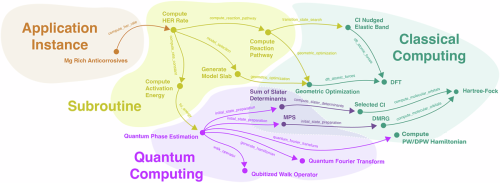
Quantum computing for corrosion simulation
The project employs quantum-enabled workflows for aircraft corrosion modeling. Yet the program's budget was only $2.5 million, and it was explicitly positioned as an experimental effort. The exact contribution of the quantum component and the magnitude of any resulting acceleration have not been disclosed publicly.
The common thread across all three examples is straightforward.
Quantum computing is not useless.
It simply cannot complete these tasks independently.
It requires a classical host environment.
IV. A Shift in the Industry's Communication Priorities
Comparing public messaging from quantum computing companies in 2020 with that of 2026 reveals a noteworthy trend.
Around 2020, the industry's primary metric was qubit count. IBM announced the Condor processor with 1,121 qubits in December 2023. Google introduced the Willow processor with 105 qubits in December 2024. IonQ and Quantinuum likewise publicized the scale of their systems. Media coverage focused almost exclusively on one question: who had more qubits?
In December 2024, Google's Willow chip achieved one of the most important experimental milestones in quantum computing in three decades: demonstrating below-threshold quantum error correction for the first time.
Yet an equally important detail emerged afterward. During public interviews in early 2026, Google CEO Sundar Pichai suggested that practical quantum computing remained five to ten years away—a notably more cautious timeline than the optimism surrounding the "quantum supremacy" era in 2019.
At the same time, the industry's communication priorities have been shifting in subtle but persistent ways.
In November 2024, IBM shut down the notebook environment within Quantum Lab, handing the interactive programming layer to third-party platforms such as qBraid and Strangeworks while focusing internally on Qiskit Runtime as a pure computing service. IBM's Spectrum LSF workload scheduler now treats Qiskit Runtime primitives as HPC resources alongside CPU and GPU nodes.
At AWS re:Invent 2025, Amazon expanded the integration between Braket and SageMaker, incorporating quantum circuit execution directly into classical machine-learning pipelines.
Microsoft's Azure Quantum Elements 2.0 tightly integrated quantum chemistry simulation capabilities with Azure AI services.
The signal behind these moves is consistent.
Quantum computing is increasingly being repositioned as a computing resource that can be embedded into existing cloud infrastructure rather than as a standalone hardware product.
The emphasis used to be on qubit counts, quantum supremacy, quantum advantage, and the performance of independent systems.
Today, the emphasis is on workflow integration, hybrid architectures, cloud accessibility, and compatibility with existing platforms.
This is not a retreat from quantum computing.
It is a redefinition of what a quantum computer is.
V. The FPGA Lesson
When discussing the future of quantum computing, GPUs are often used as an analogy.
Yet the historical path of GPUs does not perfectly match the situation quantum computing faces today.
GPUs never promised to replace CPUs. They began as graphics accelerators. Later, their parallel processing capabilities enabled general-purpose GPU computing (GPGPU), and eventually they became the default infrastructure for AI training.
The success of GPUs was built on a simple proposition: they were 10 to 100 times faster than CPUs for specific workloads while requiring relatively little integration effort.
Quantum computing followed a different narrative. During the quantum supremacy era, it implicitly suggested the possibility of replacing certain forms of classical computing. The term itself carried a confrontational implication.
As a result, the GPU story of peaceful coexistence does not fully capture the current reality of quantum computing.
A more useful analogy may be FPGA technology.
In 1985, Xilinx introduced the XC2064, the world's first FPGA. It was positioned as a prototyping tool for application-specific integrated circuits (ASICs). It excelled at certain tasks but lacked general-purpose flexibility. Programming was difficult, requiring hardware description languages. Development costs were high, and the surrounding ecosystem remained immature.
Those characteristics resemble the current state of quantum computing remarkably closely.
The turning point for FPGAs arrived in 2017.
Microsoft deployed FPGAs at scale across its data centers to accelerate Bing search, and Xilinx subsequently announced a "Datacenter First" strategy.
The critical shift was conceptual.
FPGAs were no longer marketed as potential replacements for CPUs. Instead, they were repositioned as reconfigurable accelerators within data centers—coexisting with CPUs and GPUs while handling specific classes of workloads.
According to ACM Queue's The History, Status, and Future of FPGAs (2019/2020), FPGAs had become a standard data-center component by the early 2020s, despite maintaining a market size far smaller than either CPUs or GPUs.
They found their place.
They never became the main character.
Quantum computing may be moving toward a similar destination.
In practice, there are two historical paths:
Path A (The GPU Path): Expansion
CPU → GPU
GPUs evolve into broadly applicable parallel processors and eventually achieve market significance comparable to CPUs.
Path B (The FPGA Path): Specialization
CPU → FPGA
FPGAs remain specialized accelerators for particular workloads. They never replace CPUs, yet they become indispensable components within modern data centers.
Today, quantum computing looks much closer to Path B.
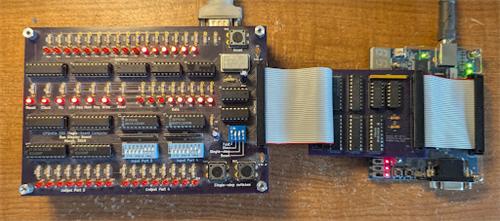
An FPGA Processor
Its measure of success may not be how much faster it is than classical computing.
The real question may be which specific tasks make it an irreplaceable component within a larger classical workflow.
VI. If the Pivot Succeeds, What Will the Industry Look Like?
If the "quantum accelerator" model becomes the dominant paradigm, several aspects of the quantum computing industry are likely to change.
Business Models: From Hardware Sales to Cloud Services
The $15 million Quantum System One model may survive only for a handful of customers such as national laboratories.
Most enterprises will access quantum computing through platforms such as AWS Braket, Azure Quantum, and IBM Quantum Cloud, paying only for the resources they consume.
MarketIntelo reports that public quantum cloud services are already growing at a compound annual rate of 29.3%, while hybrid deployment models are expanding at more than 47.2%.
Competitive Dynamics: From Qubit Counts to Developer Experience
Competition may shift away from "who has more qubits" and toward "who provides the most seamless API" and "who integrates most effectively with classical infrastructure."
IBM's Qiskit Runtime, Amazon's Braket Hybrid Jobs, and Microsoft's Azure Quantum Resource Estimator all compete primarily on usability and integration rather than hardware specifications.
Investment Logic: From Betting on Quantum Hardware to Betting on Quantum Infrastructure
Investors may increasingly shift from betting on individual quantum computer manufacturers to betting on the idea that quantum computing becomes a standard component of future data centers.
If that happens, the ultimate winners may not be the companies building quantum processors.
The winners may be the cloud providers that package quantum hardware into services developers can actually use.
However, it is important to emphasize that this transition remains unproven.
Its success depends on two assumptions that have yet to be validated.
First, quantum accelerators must demonstrate an order-of-magnitude performance advantage on at least one real-world enterprise workload rather than merely excelling on carefully designed benchmark problems.
Second, the cost of integrating quantum computing must fall to the point where using it becomes as simple as calling a cloud API rather than requiring teams of specialized quantum algorithm engineers.
VII. Conclusion
When Xilinx introduced the first FPGA in 1985, few people could have predicted that four decades later it would become the "third chip" in the data center alongside CPUs and GPUs.
Its success did not come from replacing existing technologies.
It came from finding an irreplaceable role in specific scenarios.
In 2026, quantum computing may be experiencing its own FPGA moment.
Google's Willow has demonstrated the viability of quantum error correction. IBM's modular systems have illustrated a path toward scalability. Cloud-platform integration has made quantum computing accessible in ways that were previously impossible.
Yet whether these technological milestones become an industry inflection point depends on a remarkably simple question:
How much are enterprise customers willing to pay for an accelerator, and how long are they willing to wait?
This is neither the failure of quantum computing nor its triumph.
It is a pivot that is still unfolding.
References
- DataIntelo, Quantum Computing Enterprise Applications Market Research Report 2034, 2026.
- MarketIntelo, Quantum Computing as a Service (QCaaS) Market Research Report 2034, 2026.
- Quantum Zeitgeist, Top Quantum Cloud Providers 2026, 2026.
- Business20Channel, Quantum AI Power Map Redrawn, 2025.
- IntuitionLabs, IBM Quantum's Role in Pharmaceutical Drug Discovery, 2025.
- BQPSim, 5 Key Quantum Computing Breakthroughs in 2026, 2026.
- ACM Queue, The History, Status, and Future of FPGAs, 2019/2020.
- Google, Quantum Error Correction Below the Surface Code Threshold, Nature, 2024.
- IBM, IBM Quantum Heron and IBM Quantum System Two, 2023/2024.
Elena Kovacs
Emerging Technology Correspondent
Elena Kovacs focuses on frontier technologies whose commercial impact remains uncertain but potentially transformative. Her work examines where scientific breakthroughs meet engineering constraints, regulation, and economic reality.
Recommended for you