The Hidden Battle Beneath Satellite Internet

Why Starlink, Kuiper, and OneWeb Are Discovering That Space Is Cheaper Than Regulatory Approval
By Daniel Falk
Aerospace & Autonomous Systems Analyst
Last Updated: June 17, 2026
Reading Time: 10 min read
Most people still view the satellite internet race through a 2018 lens: who launches more satellites, whose rockets cost less, and whose coverage maps are larger. By 2026, however, the industry's reality has shifted fundamentally.
Over the past decade, the biggest challenge was getting satellites into orbit. Over the next decade, the challenge is increasingly becoming obtaining permission to use them on the ground. SpaceX's reusable Falcon 9 system has reduced the cost of a launch to roughly $67 million, while Starlink's satellite production has evolved into something resembling an automotive assembly line. Space has never been more accessible. At the same time, spectrum coordination, national regulatory approvals, data sovereignty requirements, and the development of local partnership networks are becoming more expensive and time-consuming than orbital deployment itself.
This is not a problem unique to any single company. Rather, it reflects a broader pattern in the diffusion of frontier technologies: once engineering problems begin to be solved, institutional constraints naturally emerge as the next bottleneck.
1. The Space Problem Is Being Solved
The satellite internet industry has undergone a fundamental restructuring of launch economics over the past five years. Through first-stage booster reusability, SpaceX's Falcon 9 has reduced launch costs from roughly $20,000 per kilogram to orbit during the 2010s to less than $1,500 per kilogram by 2026.
This shift has transformed the commercial viability of low-Earth-orbit (LEO) constellations. Projects that once required investments measured in tens of billions of dollars can now be deployed with budgets in the single-digit billions.
Manufacturing has undergone a similar industrial transformation. Starlink satellites have evolved from hand-built prototypes into standardized products produced at scale through assembly-line manufacturing at the company's facility in Redmond, Washington. Industry analysts estimate that the manufacturing cost of a single Starlink satellite has fallen to roughly the $250,000 range, while launch costs continue to decline. Although Amazon's Kuiper project entered the market later, it follows a similar philosophy of industrialized production, emphasizing scalability and rapid iteration.
By early 2026, Starlink had approximately 9,500–10,000 satellites in orbit, providing service across 155 countries and territories and serving roughly 9.2 million subscribers (Quilty Space Research Report, 2026). OneWeb completed deployment of its first-generation constellation of 634 satellites and, following its merger with the European satellite operator Eutelsat in 2023, reported approximately 60% year-over-year revenue growth during 2025 and the first half of 2026, primarily driven by government and enterprise customers. Kuiper, which began launching operational satellites in April 2025, had placed 212 satellites in orbit by February 2026 and ultimately plans a constellation of 3,232 satellites (SpaceNews, 2026).
Taken together, these developments suggest that the task once considered nearly impossible—getting satellites into space—is becoming one of the more standardized and predictable elements of the satellite internet value chain.
2. Why the Ground Is More Crowded Than the Sky
One of the most common misconceptions about satellite internet is that it somehow bypasses traditional internet infrastructure. In reality, the opposite is true.
Satellites merely change the "last hop" through which data enters the internet. Eventually, traffic must still be routed through ground stations, connected to fiber backhaul networks, linked to internet exchange points, and distributed across the broader global internet.
Ground stations face significant constraints in both placement and construction. They must be close enough to population centers to minimize latency while remaining sufficiently distant from sources of electromagnetic interference. Operators must secure local spectrum licenses and negotiate interconnection agreements with domestic telecommunications providers. Starlink has deployed hundreds of ground stations worldwide, yet every new country requires a fresh round of negotiations covering site selection, power infrastructure, and fiber connectivity. These tasks cannot be accelerated through technological breakthroughs; they must be completed market by market.
A deeper challenge is that satellite internet does not create an entirely new set of rules separate from the existing telecommunications ecosystem. Instead, it adds a new access layer to an already established regulatory framework.
As a result, operators must simultaneously comply with International Telecommunication Union (ITU) spectrum coordination requirements, national telecommunications licensing regimes, data localization laws, and increasingly stringent national security reviews.
India provides a useful example. In May 2026, the country's Department of Telecommunications (DoT) formally approved Starlink's entry into the Indian market, but only under a series of conditions. The company was required to establish local gateways within India, comply with data localization requirements, and operate through domestic partnerships. Around the same time, satellite services backed by Reliance Jio and SES, along with OneWeb's Indian operations, were also moving toward commercial deployment. All three operators faced the same regulatory framework, yet each pursued a distinctly different compliance strategy and partnership structure (The Hindu Business Line, 2026).
South Africa illustrates a different form of ground-level cost. Starlink's operations in the country have repeatedly encountered obstacles due to the requirements of South Africa's Broad-Based Black Economic Empowerment (B-BBEE) framework. The Independent Communications Authority of South Africa (ICASA) requires satellite operators to demonstrate that local partners meet specific ownership and governance criteria. For SpaceX, which has traditionally favored a vertically integrated operating model, this means redesigning its business structure within South Africa rather than simply selling equipment and providing connectivity services (TechCentral, 2025–2026).
The common thread across these cases is that none of the challenges involve rocket technology, satellite design, or constellation architecture. They are fundamentally terrestrial problems—questions of law, politics, governance, and commercial relationships.
3. Spectrum: The Resource That Cannot Be Manufactured
If satellites can be mass-produced and rockets can be reused, spectrum remains the one resource in the satellite internet value chain that cannot be expanded through engineering.
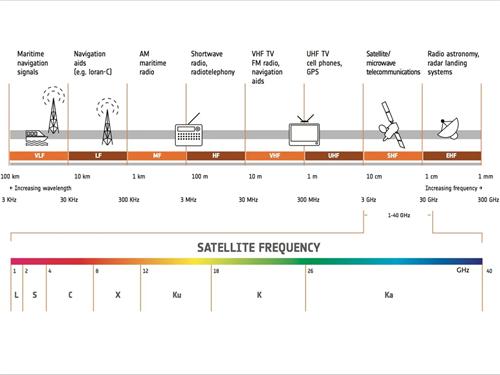
Ka-Band & Ku-Band Systems
Satellite broadband primarily relies on the Ku band (12–18 GHz) and Ka band (26.5–40 GHz). These frequencies are not reserved exclusively for satellite internet services. They are shared with terrestrial communications systems, military applications, weather satellites, and scientific research programs.
The ITU's Radio Regulations require countries to coordinate spectrum allocations internationally in order to minimize interference between competing systems. However, this coordination process moves slowly. ITU filing and coordination timelines are often measured in years rather than months.
The situation becomes even more complex as global 5G deployment accelerates. Terrestrial telecom operators are demanding increasing amounts of mid- and high-band spectrum. Disputes surrounding C-band allocation have already produced years of conflict between satellite operators and mobile carriers in the United States. Similar battles between terrestrial and space-based networks are emerging around the world.
Satellite operators can build more satellites, but they cannot manufacture additional spectrum. They can improve signal-processing algorithms, but they cannot circumvent the physical limitations of bandwidth.
Spectrum scarcity introduces another hidden cost: coordination. Every time a satellite operator enters a market where frequencies must be shared with existing providers, it must invest significant resources into interference analysis, technical negotiations, and regulatory advocacy. These costs rarely appear on launch budgets, yet they consume real money, real time, and directly affect service deployment schedules.
4. Global Connectivity Is Becoming More Local
One of the original promises of satellite internet was universal coverage: users could connect to the same network regardless of where they were located. By 2026, reality is moving in the opposite direction.
Europe is advancing the IRIS² sovereign satellite constellation initiative to reduce dependence on non-European providers. India requires satellite operators to comply with local data-storage and partnership rules. China is accelerating deployment of its Guowang and Qianfan constellations, which are expected to include roughly 13,000 low-Earth-orbit satellites, although their commercial strategies and coverage plans remain largely opaque to outside observers. Countries such as South Africa and Nigeria are also using regulatory tools to strengthen domestic control over satellite communications services.
The common trend is clear. While the technical capability for global coverage continues to expand, a unified global market is not emerging alongside it. Instead, markets are fragmenting along sovereign boundaries. Individual countries and regions are creating their own access requirements, and those requirements are rarely interoperable.
For operators, this means that "global service" is no longer a product that can be designed once and deployed everywhere. It increasingly resembles a series of localization projects that must be adapted market by market.
Starlink's vertically integrated model—designing satellites, building rockets, and selling services directly—provides significant efficiencies in space. On the ground, however, the same model can become a regulatory liability. Governments often want to see local partners, local investment, and local job creation. A foreign company that prefers to do everything itself may struggle to meet those expectations.
5. The Aviation Industry Offers a Glimpse of the Future Market
The in-flight connectivity market provides an excellent window into how competitive dynamics in satellite internet are evolving.
Airlines possess three characteristics that make them especially revealing customers: they require global coverage, they sign high-value contracts, and they are exceptionally sensitive to reliability.
Between 2025 and 2026, major airlines increasingly began choosing sides. United Airlines, Hawaiian Airlines, and the IAG Group (British Airways and Iberia) selected Starlink. JetBlue Airways signed with Kuiper. Air Canada and the Lufthansa Group adopted OneWeb-based solutions. These decisions were rarely driven by pure technical specifications. Instead, they depended more heavily on global support capabilities, regulatory adaptability, and long-term service commitments (Satellite Today, 2026).
Airline connectivity contracts typically span five to ten years. Once signed, switching costs become extremely high. As a result, decisions made in 2026 may effectively determine market share through the early 2030s.
More importantly, these contracts reveal a deeper shift in the nature of competition. Technical advantages are gradually becoming commoditized, while execution capabilities—including global support networks, regulatory compliance expertise, and customer service responsiveness—are emerging as the key differentiators.
One procurement executive at a European airline reportedly told industry media that the technological gap between the major providers had narrowed to the point where it was difficult to use as a decisive selection criterion. What ultimately mattered was a far more practical question: when an aircraft experiences a connectivity failure at a remote airport, which provider can dispatch an engineer within 24 hours?
For airlines that may lose hundreds of thousands of dollars per day when aircraft are grounded, that is not a technology decision. It is a risk-management decision.
6. Where the Next Battleground Will Be
Predicting the ultimate winners is difficult. Predicting the next set of constraints is somewhat easier.
Direct-to-cell connectivity is likely to become the next major source of spectrum conflict. Partnerships such as Starlink and T-Mobile, along with initiatives led by AST SpaceMobile, aim to deliver satellite signals directly to consumer smartphones. Achieving that goal requires coordination with terrestrial mobile operators in each country, and those operators are often reluctant to share valuable spectrum assets.
Enterprise private networks and sovereign networks are likely to continue growing. More governments are beginning to view satellite internet as critical infrastructure and are increasingly inclined to support domestic or regional constellation projects rather than relying exclusively on foreign providers.
The convergence of AI and satellite infrastructure represents a longer-term trend. Future AI systems, autonomous vehicles, drones, and robotic platforms will require persistent, low-latency global connectivity. Satellite networks may become part of the nervous system that enables these technologies. Yet their deployment speed will remain constrained by the same institutional and regulatory adaptation challenges that exist today.

Mind Map of AI Based Future Space & Satellite Integrated Solutions
Conclusion
Over the past decade, the satellite internet industry solved the rocket problem, the satellite problem, and the launch problem.
Over the next decade, it must solve the sovereignty problem, the regulatory problem, the spectrum problem, and the trust problem.
Space is becoming cheaper. Earth is becoming more expensive.
That is not merely a challenge for Starlink, Kuiper, and OneWeb. It is a challenge facing nearly every frontier technology seeking to scale across global markets. Before those technologies can achieve worldwide adoption, they must first pass through the increasingly complex gates of regulation, sovereignty, and local legitimacy.
References
1. Eutelsat Group. (2025–2026). Annual financial report and LEO connectivity segment performance. Eutelsat Communications S.A. https://www.eutelsat.com/en/investors/financial-publications.html
2. Federal Communications Commission. (2025–2026). Space station authorizations and market access grants: Amazon Kuiper Project Kuiper System [DA/FCC Nos. 20–102, 23–328, 25–112]. FCC Electronic Comment Filing System. https://www.fcc.gov/ecfs/search/proceedings?q=name:((20-102))
3. International Telecommunication Union. (2024–2026). Radio Regulations: Edition of 2024 (ITU-R Vol. 1). Geneva: ITU Publications. https://www.itu.int/pub/R-REG-RR
4. Quilty Space. (2026). LEO broadband market assessment: Subscriber growth, constellation deployment, and competitive dynamics [Industry research report]. Quilty Analytics. https://www.quiltyspace.com/
5. Reuters. (2026, May 28). India's DoT approves Starlink satellite internet services with local compliance conditions. Thomson Reuters. https://www.reuters.com/
6. Satellite Today. (2026). Airline connectivity contracts: Starlink, Kuiper, and OneWeb in the aviation Wi-Fi market [Market analysis]. Access Intelligence, LLC. https://www.satellitetoday.com/
7. SpaceNews. (2026, February). Amazon's Project Kuiper reaches 212 satellites in orbit, seeks FCC deadline extension. Pocket Ventures, LLC. https://spacenews.com/
8. TechCentral. (2025–2026). Starlink South Africa operations face B-BBEE compliance hurdles and ICASA licensing delays [Series of reports]. Naspers Limited. https://techcentral.co.za/
9. The Hindu Business Line. (2026, May). Starlink, Jio-SES, and OneWeb race for satellite internet commercial launch in India. The Hindu Group. https://www.thehindubusinessline.com/
Daniel Falk
Aerospace & Autonomous Systems Analyst
Daniel Falk analyzes autonomous systems, aerospace technologies, and next-generation connectivity networks. He is particularly interested in how technical standards and regulatory frameworks shape competition long before products reach mass adoption.
Recommended for you