AI Coding's New Problem: Configuration Debt Is the New Technical Debt

We solved typing. We automated boilerplate. Then we spent the saved time wiring AI tools together.
By Matteo Ricci
AI Systems & Developer Tools Analyst
Last Updated: May 6, 2026
Reading Time: 14 min read
Back in 2023, when GitHub Copilot began reaching mainstream adoption, the developer community was debating a single question: Would AI make programmers obsolete?
At the time, most people saw AI coding tools as a way to reduce workload—less repetitive coding, fewer late-night debugging sessions, and faster delivery.
Three years later, in 2026, the conversation has changed.
Spend a few minutes listening to developers around any engineering team's coffee machine, and you'll hear a very different set of complaints:
"I used Cursor to scaffold the frontend, then switched to Claude Code to resolve a cross-file type conflict. The two tools generated different interface definitions, and I spent forty minutes reconciling them."
"Our team installed five MCP servers last week. Now we have piles of JSON configuration files, and our platform engineers spend two hours a day dealing with token refresh issues."
"I'm paying for Cursor, Claude Pro, GitHub Copilot, and Perplexity. That's nearly $200 a month, and honestly, I probably use only forty percent of what I'm paying for."
Hidden inside these conversations is a counterintuitive reality:
Coding time has gone down. Delivery speed has gone up. Yet many developers feel more exhausted than before.
The reason is that another category of work has quietly expanded:
Configuring tools. Managing context. Debugging agents. Maintaining MCP integrations. Choosing models. Routing tasks. Resolving conflicts between systems.
These activities rarely appear in Jira tickets. They aren't counted in sprint story points. Yet they consume real time and real cognitive energy.
This leads to the central idea of this article.
Technical Debt is the cost left behind by code.
Configuration Debt is the cost left behind by AI workflows.
More specifically:
Configuration Debt is the hidden cost generated by maintaining AI tools, integrations, context transfer mechanisms, and orchestration layers. It is not a code-quality problem. It is a workflow architecture problem.
It isn't a bug in any particular tool. It isn't a flaw in any specific model.
It is a new category of systemic cost that developers must learn to manage in the age of AI-assisted software development.
Part 1: The AI Coding Paradox — Productivity Increased, Complexity Didn't Disappear
From the Single-Tool Era to the Tool Ecosystem Era
Many people assume the evolution of AI coding tools follows a simple progression:
Copilot
↓
Cursor
↓
Claude Code
↓
MCP
As if each generation replaces the previous one.
In reality, that's not what happened.
Instead, developers accumulated tools:
Copilot
+
Cursor
+
Claude Code
+
ChatGPT
+
MCP
+
Local Models
You didn't upgrade from Cursor to Claude Code.
You use Cursor inside your IDE while running Claude Code in the terminal for more complex debugging. Meanwhile, ChatGPT is open in a browser tab for documentation lookups, and GitHub Copilot is still handling autocomplete suggestions in the background.
This isn't replacement.
It's stacking.
According to observations discussed in Fragmented Podcast's early-2026 episode The AI Coding Ladder, most people talk about "AI coding" as if it were a single thing. In reality, it encompasses at least four distinct paradigms, each with different workflows, expectations, and mental models.
Four Generations Coexisting Simultaneously
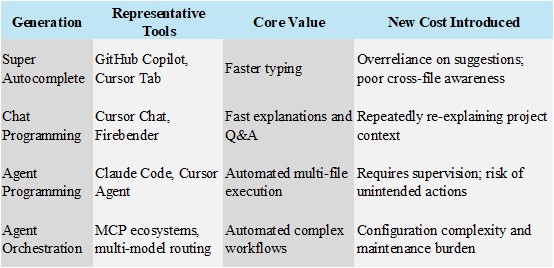
The key insight is simple:
AI reduces coding complexity while increasing orchestration complexity.
When you use only Copilot, your primary skill is pressing the Tab key.
When you use Copilot, Cursor, Claude Code, and MCP together, you must constantly decide:
- Which tool should handle this task?
- How should outputs be coordinated?
- How should context be transferred?
- How should conflicts be resolved?
Imagine a chef who once only needed to cook.
Now the chef has four highly capable assistants.
The assistants are talented, but they don't communicate with one another.
Suddenly, managing the assistants becomes a job of its own.
Part 2: The Three Major Sources of Configuration Debt
Source #1: Context Transfer Debt
This is arguably the most important, most invisible, and most underestimated form of debt.
Developers are increasingly becoming context couriers.
A typical workflow looks like this:
Cursor (frontend components)
↓
Claude Code (backend integration)
↓
ChatGPT (library research)
↓
GitHub Copilot (test generation)
Every tool switch requires re-explaining:
- What the project is about
- Current implementation status
- Design objectives
- Previous decisions
- Existing constraints
AI systems are intelligent.
Their memory, however, is fragmented.
Cursor doesn't know what Claude Code did ten minutes ago.
Claude Code doesn't know what architectural decisions were discussed inside ChatGPT.
Each tool is effectively a smart but forgetful assistant.
I know a full-stack developer who experienced this firsthand while building a SaaS product.
He used Cursor Agent to generate database schemas and API routes.
Then he switched to Claude Code to fix a complicated authorization bug.
While simplifying the logic, Claude Code quietly modified one API response format.
Later, he returned to Cursor to continue frontend work and discovered that the frontend components were now based on invalid assumptions about the API structure.
It took nearly an hour to identify the issue.
Not because the code was broken.
But because the context between tools had never been synchronized.
That is Context Transfer Debt.
It doesn't show up in logs.
But it consumes real time and real attention.
Source #2: Tool Orchestration Debt
MCP (Model Context Protocol) has become one of the most important infrastructure layers in AI development by 2026.
It is often described as "the USB-C of AI"—an open standard that allows agents to connect to tools, databases, and APIs without requiring custom integrations for every application.
By mid-2026, MCP had effectively become a de facto standard.
Claude Code, Cursor, GitHub Copilot, and ChatGPT Desktop all support it natively.
The Linux Foundation hosts the project.
Monthly downloads exceed 97 million.
More than 10,000 public servers exist.
Yet there is a gap between MCP's promise and its practical reality.
MCP solves tool-to-system connectivity.
It does not solve tool-to-tool connectivity.
You can connect GitHub to Claude Code.
You can connect GitHub to Cursor.
Claude Code and Cursor still do not talk directly to each other.
An even more subtle challenge is maintenance.
In its 2026 MCP decision guide, Arcade.dev argued that organizations consistently underestimate the operational burden of self-managed MCP runtimes.
Every upstream SaaS API change.
Every OAuth token expiration.
Every deprecated schema.
All require ongoing engineering attention.
"Configuration hell" is not hypothetical.
It is real.
The problem became significant enough that an arXiv paper published in May 2026 proposed a system called DeltaMCP to automate incremental MCP server updates because manual maintenance was becoming increasingly unsustainable.
Source #3: Model Routing Debt
The model release wave of April 2026 accelerated another trend.
GPT-5.5, Claude Opus 4.7, and DeepSeek V4-Preview were released within days of one another, driving adoption of multi-model routing architectures.
The idea sounds elegant:
Simple classification tasks
→ DeepSeek V4-Flash ($0.14/MTok)
Complex architecture refactoring
→ Claude Opus 4.7 ($15/MTok)
Multimodal tasks
→ Gemini 3.1 Pro
In practice, however, somebody must maintain:
- A task classifier
- Routing rules and weights
- Cost monitoring systems
- Quality feedback loops
As Essa Mamdani wrote in a 2026 engineering handbook:
"Without a feedback loop that tracks cost, latency, and user satisfaction for every routing decision, routing becomes vibe coding with a billing statement attached."
One engineering team routed what appeared to be a simple bug fix to a cheaper model.
Three minutes later, the developer discovered that the issue involved architectural interface decisions.
The low-cost model confidently proposed a solution that broke existing contracts.
The team spent two hours rolling back changes and redoing the work.
Using Claude directly would have been faster.
The lesson is straightforward:
Routing itself becomes another system that requires maintenance.
Every time you celebrate multi-model routing, remember that you've also created another component that must be monitored, tuned, and debugged.
Part 3: Why Configuration Debt Is Harder to Detect Than Technical Debt
Technical debt is visible.
Its symptoms are familiar:
- More bugs
- Messier code
- Harder refactoring
- Slower onboarding
You can measure it.
You can discuss it in code reviews.
You can scan for it with tools.
Configuration Debt is largely invisible.
Its symptoms look different:
- Agents suddenly seem less capable
- AI output quality fluctuates
- Workflows mysteriously slow down
- Team velocity declines
The root causes are often hidden:
- A model provider silently updated weights
- MCP schemas consumed too much context window space
- Routing logic selected a high-latency endpoint
- Developers spent half their day switching tools
When teams encounter these problems, their first reaction is often:
Add another tool. Change the model. Adjust the configuration.
Unfortunately, that frequently worsens the situation.
Problem appears
↓
Switch models
↓
Add tools
↓
Increase complexity
↓
Problem becomes worse
This is the Configuration Debt Spiral.
It resembles the classic technical debt spiral.
The difference is that every new tool appears to be solving a problem while simultaneously creating another one.

Part 4: AI Fatigue Is a Symptom, Not the Disease
By 2026, "AI Fatigue" has become a recognized phenomenon.
Many people attribute it to rapid technological change or information overload.
Those explanations only scratch the surface.
A 2026 survey conducted by Clearing AI covering 2,147 developers across 46 countries found:
- 62% identified constant switching between AI tools as their primary source of fatigue
- This exceeded concerns about job displacement and skill degradation
- 71% felt like intermediaries reviewing code they didn't write
- 67% reported lower craftsmanship satisfaction compared with twelve months earlier
- 58% reported measurable declines in core coding skills
One finding was especially surprising:
Developers using Tier-1 full-featured coding agents such as Cursor and Claude Code reported the highest fatigue levels.
Not because they produced less.
Because they produced more while understanding less.
The mechanism is straightforward:
Configuration Debt
↓
More Tools
↓
More Context Switching
↓
More Supervision
↓
Decision Fatigue
↓
AI Fatigue
AI Fatigue is not the root cause.
It is the symptom of accumulated Configuration Debt.
Several patterns repeatedly emerge:
Tool Collection Syndrome
Developers constantly chase the next tool.
This week it's Windsurf.
Next week it's Qwen3 Coder Next running locally.
The tool stack grows endlessly, but few tools are ever fully mastered.
Configuration Optimization Addiction
Developers believe one more prompt tweak, one more routing adjustment, or one more MCP integration will finally create the perfect workflow.
Eventually, more time is spent optimizing the workflow than benefiting from it.
Automation Worship
Everything gets delegated to agents.
Eventually, the maintenance cost of the automation exceeds the cost of the original task.
One developer told me he spent three full days getting Claude Code to automate a CI/CD pipeline. Building it manually would have taken two hours.
This hidden cost of tool stacking resembles the subscription fatigue that emerged during the streaming boom of 2022–2023. Every new service promised convenience. Every individual subscription seemed reasonable. Over time, however, users discovered they were spending increasing amounts of money, attention, and effort simply managing subscriptions rather than enjoying the content itself.
A similar pattern is emerging in AI-assisted development. Each new coding assistant, MCP integration, routing layer, or workflow automation appears valuable in isolation. Together, they can create an ecosystem that requires constant supervision and maintenance.
The Clearing's survey data revealed that 71% of developers increasingly feel like intermediaries—reviewing, validating, and approving code they did not write themselves. Many describe their work as less about building software and more about coordinating a collection of AI systems that participate in building it.
The result is a subtle shift in the nature of software engineering. Developers are no longer spending all of their cognitive energy solving technical problems. Increasingly, they are spending that energy managing workflows, maintaining context, evaluating outputs, and resolving conflicts between tools.
AI Fatigue is not the disease.
It is often the symptom of Configuration Debt reaching a level where the coordination overhead becomes impossible to ignore.
Part 5: Why Developers Still Accept Configuration Debt
At this point, an important balance must be acknowledged.
This is not an argument against AI coding.
In fact, the existence of Configuration Debt demonstrates how valuable AI coding has become.
Consider a simple comparison.
Without AI:
8 hours of development
With AI:
2 hours maintaining workflows
+
4 hours building software
=
6 hours total
Even after paying the Configuration Debt tax, developers still come out ahead.
That is why they willingly accept it.
The core insight is:
Configuration Debt is not evidence that AI has failed.
It is a side effect of increased productivity.
History provides similar examples:
- Cloud computing created FinOps
- Microservices created Platform Engineering
- AI coding is creating Configuration Debt
Every technological shift relocates complexity rather than eliminating it.
AI did not remove complexity.
It moved complexity from writing code to managing workflows.
Part 6: A Practical Framework for Reducing Configuration Debt
Principle 1: Minimize Tool Count
Resist the temptation to use everything.
Choose two or three core tools.
Eliminate the rest.
Fewer tools mean fewer context transfers.
Principle 2: Establish Clear Tool Ownership
Assign responsibilities explicitly.
For example:
Cursor
= Daily development and rapid iteration
Claude Code
= Deep reasoning and cross-file debugging
GitHub Copilot
= Low-friction typing acceleration
When each tool has a clearly defined territory, fewer decisions are required.
Principle 3: Create Context Handoff Protocols
Do not rely on memory.
Use explicit handoff documentation.
For example:
- Have Cursor Agent generate a TASK_SUMMARY.md
- Provide that file when switching to Claude Code
- Maintain a DECISION_LOG.md for architectural decisions
This is dramatically more reliable than trying to remember everything.
Principle 4: Use MCP Conservatively
Start with only a few essential integrations:
- GitHub
- Your database
- One documentation system
Do not install twenty MCP servers simply because you can.
Remember that loading dozens of schemas can consume tens of thousands of tokens and significantly inflate context windows.
Principle 5: Prefer Static Routing Before Dynamic Routing
Unless your organization has at least five engineers and meaningful MLOps capability, start with static rules.
Examples:
- Code generation → Claude
- Simple questions → GPT
- Documentation lookup → Local model
Avoid introducing dynamic routing prematurely.
Its maintenance burden often exceeds the API savings.
Principle 6: Preserve AI-Free Coding Time
Reserve two to three hours each week for entirely manual coding.
Not for nostalgia.
For resilience.
Clearing AI's research found that developers who maintained structured AI-free practice reported significantly lower fatigue levels.
Part 7: The Emerging Role of the AI Workflow Engineer
Over the past decade, DevOps and Platform Engineering emerged to manage infrastructure complexity so developers could focus on business logic.
The next five years may bring another specialized role:
AI Workflow Engineer.
Their job will not be writing application code.
Their job will be managing AI ecosystems.
Responsibilities may include:
- Agent governance
- MCP governance
- Prompt asset management
- Context management
- Routing optimization
Organizations will eventually discover that:
The most expensive resource is not model usage. It is the people required to maintain the model ecosystem.
As AI coding evolves from a personal productivity tool into shared organizational infrastructure, AI Workflow Engineers may follow the same path DevOps once did—from niche specialists to central members of engineering teams.
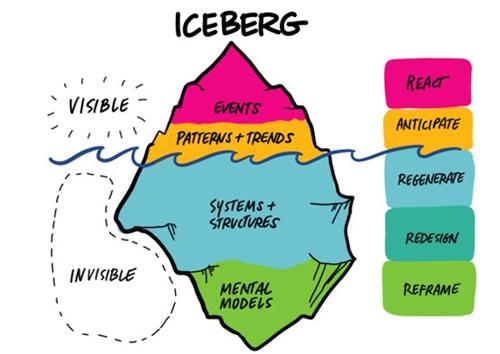
Iceberg Model – Complex Systems Frameworks Collection
Conclusion: AI Didn't Eliminate Complexity—It Relocated It
In the past:
Developers maintained code
Today:
Developers maintain code
+
Developers maintain AI workflows
AI reduced the cost of writing code.
It did not reduce the cost of coordination.
It simply moved complexity from the keyboard to the workflow architecture.
The last decade of software engineering was about managing code.
The next decade may be about managing the systems that generate code.
Or, stated more directly:
AI lowers the cost of writing code. It does not lower the cost of coordination.
Configuration Debt is not going away.
But it can be managed.
The first step is recognizing that it exists.
Give it a name.
Observe it.
Measure it.
Then build systems that keep it under control.
References
1. The Clearing. (2026). AI fatigue by the numbers: 2026 data report. The Clearing. https://clearing-ai.com/ai-fatigue-2026-numbers.html
2. Arcade.dev. (2026, May 13). Build vs. buy MCP runtime: 2026 decision guide. Arcade.dev Blog. https://www.arcade.dev/blog/mcp-runtime-build-vs-buy/
3. Souza, I., & Gopal, K. (Hosts). (2026, January 19). 301 - The AI coding ladder [Audio podcast episode]. In Fragmented: AI developer podcast. fragmentedpodcast.com. https://fragmentedpodcast.com/episodes/301/
4. Pujara, A. (2026, May 27). DeltaMCP: Incremental regeneration via spec-aware transformation for MCP servers. arXiv. https://arxiv.org/abs/2605.28148
5. Pristren. (2026, June 6). What is MCP? Model Context Protocol explained (2026). Pristren Blog. https://pristren.com/blog/what-is-mcp-model-context-protocol/
Matteo Ricci
AI Systems & Developer Tools Analyst
Matteo Ricci covers developer tools, AI-assisted software engineering, and the evolving relationship between automation and human expertise. His writing often examines the gap between technological promises and operational reality.
Recommended for you