The Great Autonomous Driving Standards Split
When the SAE Levels Stop Mapping to Reality: How Tesla, Waymo, and Mercedes Are Each Rewriting What "Autonomous" Means at the Engineering Level
By Daniel Falk
Aerospace & Autonomous Systems Analyst
Last Updated: June 3, 2026
Reading Time: 12 min read
In 2026, the autonomous driving industry is facing a notable phenomenon.
Tesla FSD (Full Self-Driving) is still classified as SAE Level 2, yet it operates across millions of vehicles worldwide. Mercedes Drive Pilot is classified as Level 3, but can only be used under specific road, weather, and speed conditions. Waymo Robotaxi is classified as Level 4, and its vehicles do not even have steering wheels.
According to the SAE J3016 definition, Level 4 > Level 3 > Level 2. But real-world user experience does not follow such a simple numerical hierarchy.
Many consumers have become confused:
Why can Tesla's Level 2 system drive on almost any road?
Why is Mercedes' Level 3 system restricted to highways, clear weather, and speeds below 95 km/h?
Why is Waymo's Level 4 system limited to operation within pre-mapped urban areas?
The issue may not be the technology itself.
The issue may be that the SAE classification system is losing its ability to describe the realities of autonomous driving in 2026.
Part I: The Original Assumptions Behind SAE Levels — And Why They Are Breaking Down
The SAE J3016 standard was first introduced in 2014 and received its third revision in 2021.
Its core design assumption was that driving automation represents a gradual replacement of human driving capability—from feet (acceleration and braking), to hands (steering), to eyes (monitoring), to brain (decision-making), with control transferred layer by layer.
This framework contains an implicit premise:
All autonomous driving systems share the same capability coordinate system.
Level 2 is an incomplete version of Level 3.
Level 3 is a transitional stage toward Level 4.
Ultimately, all systems are moving toward the same endpoint: Level 5.
The 2021 revision introduced the concept of ODD (Operational Design Domain) in an attempt to address limitations in the linear model through operational constraints.
Yet the framework itself remains hierarchical.
It still assumes that expanding the ODD is the natural result of technological progress rather than the outcome of fundamentally different technological philosophies.
The reality of 2026 challenges that assumption.
Waymo's strength—complex interactions in dense urban environments—is not the same as Tesla's strength—generalization across virtually any road environment.
Neither is equivalent to Mercedes' strength—regulatory compliance and predictable operation on structured roadways.
These are not different levels of completion for the same capability.
They are different capabilities optimized for different objectives.
Once the capability dimensions themselves diverge, using a single numerical level to compare them becomes problematic.
It is like comparing submarines and airplanes using "depth" as the measurement.
The number may be the same.
The meaning is entirely different.
Part II: Tesla — Treating Autonomous Driving as a Learning Problem
Tesla does not define its challenge as a certification problem.
It defines it as an AI learning problem.
That choice determines the core characteristics of its technical architecture:
- Vision-only perception
- End-to-end neural networks
- Billions of miles of fleet data
- Continuous data feedback loops
By May 2026, Tesla's FSD (Supervised) fleet had accumulated more than 10 billion miles of driving.
Daily data collection grew from approximately 14 million miles per day at the beginning of the year to 29 million miles per day by late April.
According to Tesla's official safety reporting, vehicles operating in FSD (Supervised) mode experienced one major collision approximately every 5.3 million miles, compared with roughly one major collision every 660,000 miles for the average U.S. driver.
However, these statistics contain a fundamental structural limitation:
Tesla is collecting supervised-driving data, not autonomous-driving data.
Under FSD (Supervised), a human driver remains responsible for monitoring the system at all times and intervenes whenever necessary.
As a result, Tesla's dataset contains a vast number of situations where the system was about to make a mistake and a human corrected it.
Those examples are extraordinarily valuable for training neural networks to recognize dangerous situations.
But they do not answer a critical question:
How would the system perform if it were truly operating independently without human backup?
Tesla's Robotaxi pilot program in Austin, Texas provides a partial answer.
By February 2026, the fleet had accumulated roughly 800,000 autonomous miles and reported 14 collisions to NHTSA.
That frequency was approximately four times higher than the accident rate of human drivers operating under comparable urban conditions.
Tesla's long-term position at Level 2 appears, on the surface, to be a technological limitation.
In practice, it may be a deliberate product-design choice.
The legal boundary of Level 2 is straightforward:
The driver remains responsible for the vehicle at all times.
Moving to Level 3 or Level 4 would require the manufacturer to assume legal responsibility under specific circumstances.
For Tesla's business model, that represents an entirely different category of decision.
For Tesla, the most important metrics are not SAE levels but three operational indicators:
- Disengagement rate
- Geographic coverage
- Data growth velocity
The question Tesla is optimizing for is:
Can AI learn how to drive?
Not:
Can regulators certify it?
Part III: Waymo — Treating Autonomous Driving as an Operating System
Waymo is not selling autonomous vehicles.
It is operating an autonomous transportation service.
That distinction fundamentally shapes its technological path.
Waymo's architecture is built around:
- High-definition mapping
- Multi-sensor fusion centered on LiDAR
- Rule-based decision systems
- Large-scale simulation and validation
Its vehicles operate inside a pre-validated virtual representation of the world.
That "world" is more than a map.
It is a comprehensive set of known rules encompassing every lane marking, every traffic signal, and every predictable interaction pattern.
In December 2024, Waymo and global reinsurance leader Swiss Re jointly published a study analyzing insurance claims from 25.3 million miles of fully autonomous driving.
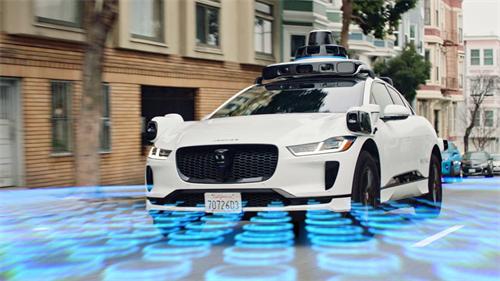
Waymo Jaguar I-Pace Self-Driving Robotaxi with LiDAR Perception Visualization
The findings showed:
Compared with human-driver baselines, Waymo Driver reduced:
- Property damage claims by 88%
- Bodily injury claims by 92%
Even when compared with modern vehicles equipped with advanced driver assistance systems (ADAS), including automatic emergency braking and lane-keeping assistance, Waymo still achieved:
- An 86% reduction in property damage claims
- A 90% reduction in bodily injury claims
Across the full 25.3 million miles, Waymo Driver was associated with only:
- 9 property damage claims
- 2 bodily injury claims
Equivalent human-driver exposure would have been expected to generate:
- 78 property damage claims
- 26 bodily injury claims
Yet the Waymo model has a structural constraint:
Every new city requires months of mapping, validation, and simulation reconstruction.
Expansion is not a copy-and-paste operation.
It requires rebuilding a digital twin of the physical environment.
By 2026, Waymo had expanded operations to more than six U.S. cities, including:
- Phoenix
- San Francisco
- Los Angeles
- Austin
- Atlanta
- Miami
The company had also begun testing in Tokyo and planned a London launch in September.
But the marginal cost of expansion does not decline with scale.
Each city represents a separate world-building project.
Waymo is not pursuing "anywhere driving."
It is pursuing reliable driving within defined domains.
This is not a difference between conservative and aggressive strategies.
It is a fundamentally different technological paradigm from Tesla's approach.
Part IV: Mercedes — Treating Autonomous Driving as a Certifiable Product
In 2021, Mercedes Drive Pilot became the first production SAE Level 3 system approved by Germany's Federal Motor Transport Authority (KBA).
It was later approved in California and Nevada as well.
However, the operational restrictions were extremely strict.
The system could only operate under conditions including:
- Highway driving
- Favorable weather
- A lead vehicle present
- Staying within the same lane
- Speeds below 95 km/h
In addition, the driver had to resume control within 10 seconds after receiving a takeover request.
In early 2026, Mercedes announced that Drive Pilot would no longer be offered on refreshed S-Class and EQS models.
Instead, the company shifted toward MB.Drive Assist Pro (L2++).
Around the same time, BMW confirmed that the 2027 facelifted 7 Series would discontinue Personal Pilot L3.
Many observers interpreted these decisions as evidence of technological failure or weak consumer demand.
Viewed through the lens of certification engineering, however, they reveal a deeper structural issue:
The Level 3 human-machine co-driving model may be inherently unsustainable.
The central paradox of Level 3 is that it requires drivers to disengage completely while the system is operating—hands off and eyes off.
Yet it simultaneously requires them to instantly regain control when requested.
Extensive human-factors research has demonstrated that situational awareness deteriorates significantly after prolonged disengagement from the driving task.
Google's decision to abandon the Level 3 pathway in 2016 was largely influenced by observations from early testing that highlighted this problem.
Mercedes' strict limitations—clear weather, highways, speeds below 95 km/h, and the presence of a lead vehicle—are not signs of technological weakness.
Quite the opposite.
These constraints are prerequisites for legal approval.
Every restriction corresponds to a verifiable safety boundary and a clearly defined liability framework.
In other words, Mercedes is not primarily solving the question:
Can autonomous driving be achieved?
It is solving the question:
Can autonomous driving be legally defined, validated, and insured?
Its engineering objective is not maximizing capability.
It is maximizing certifiability.
Part V: Why Level 3 May Be a Structurally Awkward Layer
By 2026, industry investment and engineering talent have increasingly migrated away from Level 3 and toward two opposite ends of the spectrum:
- L2++ systems (the Tesla approach)
- L4 Robotaxis (the Waymo approach)
The challenges facing Level 3 are not unique to any one manufacturer.
They stem from structural weaknesses inherent to the category itself.
Driver Takeover Problem
Level 3 requires humans to resume control when requested.
However, cognitive research consistently shows that situational awareness declines after extended periods of non-participation.
A theoretical 10-second takeover window may appear sufficient.
In real emergencies, it often is not.
Ambiguous Legal Responsibility
Level 3 creates the most complicated liability model in autonomous driving.
When the system is active, responsibility may belong to the manufacturer.
After takeover, responsibility shifts to the driver.
But determining whether a takeover was successful—or whether it was even realistically achievable—introduces substantial legal ambiguity.
This makes insurance pricing and liability allocation extremely difficult.
Limited Commercial Value
Mercedes Drive Pilot carried an option price ranging from €6,000 to €9,000.
Yet because of its restrictive ODD, the system's practical usability remained extremely limited.
Consumers were paying a substantial premium for the ability to look at their phones during very specific highway conditions.
That value proposition has proven difficult to scale into the mass market.
User Understanding Challenges
The user contract of Level 2 is relatively straightforward:
Hands on the wheel.
Eyes on the road.
Level 4 is equally clear:
No human intervention required.
Level 3 sits uncomfortably in between.
Sometimes the driver is needed.
Sometimes the driver is not.
This ambiguity is difficult for users to understand and trust.
The critical question remains:
Is Level 3 a technical obstacle that must eventually be overcome?
Or is it a transitional form that perhaps never should have existed in the first place?
Industry developments in 2026 increasingly point toward the latter interpretation.
The answer, however, is not yet definitive.
Part VI: The Real Competitive Dimensions Have Changed
If SAE levels are losing their comparative value, what dimensions actually matter?
The following four metrics provide more insight than level numbers alone:
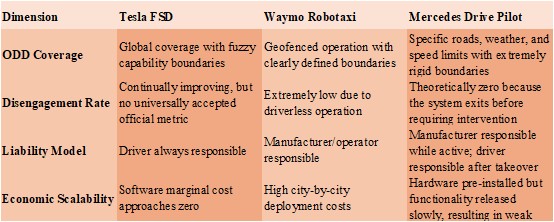
Comparison Table of Tesla FSD, Waymo Robotaxi and Mercedes Drive Pilot Autonomous Driving Systems
These dimensions reveal a crucial fact:
The trade-offs are not interchangeable.
Waymo cannot reduce expansion costs by sacrificing ODD certainty.
ODD certainty is the foundation of its safety model.
Tesla cannot restrict ODD coverage in exchange for cleaner liability boundaries.
Doing so would fundamentally alter the nature of the product.
Mercedes cannot loosen ODD constraints to improve scalability.
Regulatory frameworks would not permit it.
This is why autonomous driving in 2026 is no longer a race to Level 5.
Each pathway solves a different problem.
Each pathway creates a different problem.
They are no longer competing on the same track.
They are redefining the track itself.
Part VII: After SAE — Where Might Standards Evolve?
If numerical levels are no longer sufficient, what could replace them?
The aviation industry offers a useful comparison.
Aircraft autoland systems do not use level-based classifications.
Instead, they employ condition-based categories:
- CAT I (Decision height: 200 ft; Runway visual range: 550 m)
- CAT II (100 ft; 300 m)
- CAT IIIa (Below 100 ft or no decision height; 200 m)
- CAT IIIb (Below 50 ft or no decision height; 75 m)
The core principle is not how autonomous the aircraft is.
The question is:
Under what conditions does the system achieve a lower failure probability than human operators?
This framework incorporates three elements:
- Operational conditions (analogous to ODD)
- System redundancy (fail-passive versus fail-operational)
- Quantifiable risk metrics
Future autonomous driving standards may evolve in a similar direction.
ODD-Based Standards
Instead of asking:
"What level is this system?"
The question becomes:
"In which scenarios has this system been validated?"
Risk-Based Metrics
Examples include insurance-claim frequency models developed through collaborations such as Waymo and Swiss Re.
Quantifiable probabilities of harm may eventually replace abstract level labels.
Reliability Metrics
Measures such as:
- Serious accidents per million miles
could become analogous to aviation's accident-per-million-flight-hours metrics.
Human-Machine Authority Transfer Protocols
Such frameworks would address the central paradox of Level 3 by clearly defining:
- When control must be transferred
- Under what conditions transfer occurs
- What tolerance and fallback mechanisms are required
These possibilities are not predictions.
They are analyses of plausible pathways for standard evolution.
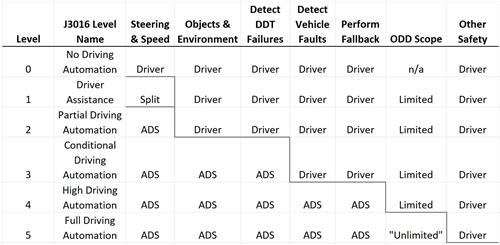
SAE J3016 Automated Driving Levels Responsibility Allocation Table
The introduction of ODD into SAE J3016 in 2021 already hinted at the need to move from a purely hierarchical model toward a condition-based framework.
A complete restructuring of the standard, however, may require a much broader industry consensus.
References
- SAE International, SAE J3016_202104: Taxonomy and Definitions for Terms Related to Driving Automation Systems, 2021.
- Waymo & Swiss Re, New Swiss Re Study: Waymo Is Safer Than Even the Most Advanced Human-Driven Vehicles, December 2024.
- Electrek, Tesla Reaches 10 Billion FSD Miles — Is There a Magical Milestone for Autonomy?, May 2026.
- Electrive, Mercedes Pauses Level 3 Driving Assistance – For Now, January 2026.
- WardsAuto, Mercedes-Benz Shifts Autonomous Driving Tech in 2026 S-Class, February 2026.
- The Last Driver License Holder, Mercedes And BMW Abandon Level 3, February 2026.
- NHTSA, Investigation PE25002: Waymo LLC Automated Driving System, May 2025.
- Carnegie Mellon University, SAE J3016 User Guide.
- ICAO/FAA, Category III Precision Approach and Autoland Standards.
Daniel Falk
Aerospace & Autonomous Systems Analyst
Daniel Falk analyzes autonomous systems, aerospace technologies, and next-generation connectivity networks. He is particularly interested in how technical standards and regulatory frameworks shape competition long before products reach mass adoption.
Published in June 2026. All statistics and information reflect the latest publicly available data accessible at the time of publication.
Recommended for you