The Great Memory Divide
Why Computing No Longer Has a Single Memory Roadmap
By Lucas Reinhardt
Senior Semiconductor Analyst
Last Updated: April 18, 2026
Reading Time: 12 min read
Until just a few years ago, if someone asked where the memory industry was headed, the answer was remarkably simple:
Wait for the next generation of DDR.
PC manufacturers, server vendors, and cloud providers all had different requirements, but they were essentially moving along the same roadmap. DDR2, DDR3, DDR4, DDR5—the debate was never about which type of memory to use. The debate was about who would adopt the next generation first.
Looking back from 2026, that level of industry-wide alignment feels almost unbelievable.
Because today's memory industry is beginning to split into three development paths that barely intersect with one another. These are not different stages along the same roadmap. They are distinct evolutionary tracks built for entirely different computing environments.
Even more interestingly, there is very little substitution between them. HBM4 will not replace DDR6. CXL will not make HBM4 obsolete. DDR6 will not unify everything under a single architecture.
I used to think this was merely temporary chaos—a byproduct of uneven technology cycles. But the longer I have followed the industry, the more it has become clear that this is not chaos at all. It is a structural split.
The biggest change in memory is not that DDR6 is arriving. It is that different computing workloads are no longer pursuing the same kind of memory.
Part I: Why NVIDIA Is Overriding JEDEC Standards
In April 2025, JEDEC officially released the HBM4 standard.
Under normal circumstances, that would have signaled the start of a predictable industry rollout.
NVIDIA had other ideas.
The JEDEC specification defines a baseline HBM4 data rate of 6.4–9.6 Gbps. NVIDIA, however, demanded that suppliers deliver more than 11 Gbps, with some configurations targeting 13 Gbps. That requirement exceeded the official standard ceiling by roughly 35%, forcing Samsung and SK hynix to redesign portions of their HBM4 die architecture and pushing mass-production schedules from late 2025 into February 2026.
The significance of this episode is not the numbers themselves.
What matters is what it reveals about a new industry reality: when AI training demand becomes large enough, memory standards can be rewritten unilaterally. JEDEC is no longer setting the roadmap. It is struggling to keep up with it.
HBM4's physical architecture explains why this kind of override became necessary.
Using 3D stacking and Through-Silicon Via (TSV) technology, HBM4 vertically stacks multiple DRAM layers and integrates them with GPU logic dies through advanced 2.5D packaging. The design sacrifices scalability and serviceability—HBM4 is soldered in place and cannot be upgraded—in exchange for a level of bandwidth density that conventional DDR can never achieve.
Its 2,048-bit interface width is 32 times wider than DDR5's 64-bit interface.
The tradeoffs, however, are equally real.
Samsung's 1c process technology (its sixth-generation 10nm-class DRAM node) reportedly improved from near-zero yields to roughly 50–60% under thermal testing conditions within a twelve-month period. That recovery process itself illustrates how different HBM4 manufacturing is from DDR manufacturing.
HBM4 is not simply a faster version of DDR.
It is a specialized solution to a bandwidth problem—so specialized that even JEDEC standards are struggling to keep pace with demand.
The supply-demand imbalance is equally revealing.
The global HBM market is expected to reach approximately $54.6 billion in 2026, representing year-over-year growth of about 58%. Yet much of the available HBM4 capacity has already been reserved through 2027 by platforms such as NVIDIA Rubin and AMD MI400.
In its April 2026 report, TrendForce reduced its forecast for Rubin's share of NVIDIA's high-end GPU shipments from 29% to 22%, while increasing Blackwell's projected share from 61% to 71%. The reason was not weak demand for Rubin. It was insufficient HBM4 supply.
Many observers still assume that HBM4 will eventually trickle down into consumer markets the way DDR generations historically have.
Reality suggests otherwise.
Consumer GPUs such as the RTX 60-series rely on GDDR7, a supply chain that is fundamentally separate from HBM4. HBM4 is not merely a premium memory product. It is a dedicated component of AI infrastructure.
Its pricing, production volume, and allocation priorities are determined by AI training demand rather than consumer electronics cycles.
The most interesting thing about HBM4 is not that it is faster.
It is that it represents a new optimization target: bandwidth.
And bandwidth is only the first sign that computing is beginning to fragment.
Part II: CXL Is Betting on Something Counterintuitive
If HBM4 is betting that bandwidth matters more than cost, CXL is betting on something even more counterintuitive:
Utilization matters more than speed.
In traditional server architectures, DRAM is tied directly to CPU sockets. Memory is allocated statically at boot time and cannot be dynamically redistributed across nodes while systems are running.
This creates a persistent but often overlooked problem.
Some servers become memory-constrained and experience performance degradation, while other servers in the same rack sit idle with large amounts of unused DRAM.
According to Dataintelo's September 2025 market research, DRAM utilization rates in conventional fixed-memory server deployments often remain around just 30–40%.
CXL (Compute Express Link) does not respond by making memory faster.
Instead, it attempts to make memory movable.
Built on the PCIe physical layer and supporting cache-coherent interconnects, CXL allows memory resources to be decoupled from CPUs and pooled across multiple systems.
CXL 2.0 introduced memory pooling. CXL 3.0 and 3.1 expanded the concept further through fabric support, allowing as many as 4,096 nodes to participate within a unified memory domain.
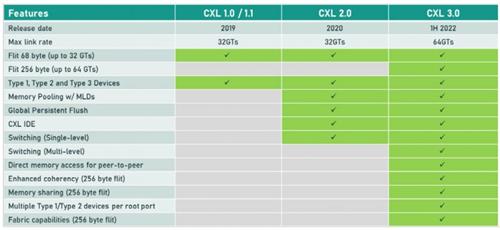
Compute Express Link (CXL)
An important detail is often overlooked:
CXL explicitly accepts higher latency than local memory.
Marvell's Structera S CXL switch reportedly achieves round-trip memory access latency below 460 nanoseconds. That is slower than local DRAM, but significantly faster than traditional RDMA-based remote memory approaches.
Research published by Alibaba Cloud and XConn in 2025 showed that CXL memory pooling enabled a sixteen-fold scalability increase in the PolarDB cloud-native database while improving throughput by a factor of 2.1.
But those gains were achieved by accepting additional latency.
Hyperscale cloud operators are willing to make that trade because their primary challenge is not single-node performance. It is resource utilization.
AWS, Azure, and Google Cloud began piloting CXL memory pooling deployments in 2025. By early 2026, Samsung had shipped more than one million CXL DRAM modules.
Yet no consumer motherboard supports CXL.
This is not a technical limitation.
It is an economic one.
The return on investment for CXL only begins to make sense at the scale of thousands or tens of thousands of servers. Most enterprises simply do not operate large enough infrastructures to justify the deployment costs of pooled-memory architectures.
The boundary between CXL and HBM4 is actually less rigid than it first appears.
Future AI inference systems may require both HBM bandwidth and CXL pooling capabilities. The two technologies may eventually coexist within the same cluster.
But their evolutionary logic remains fundamentally different.
HBM4 optimizes for extreme bandwidth.
CXL optimizes for resource utilization.
DDR6 optimizes for a balance of cost, compatibility, and practicality.
Part III: DDR6's "Mediocrity" Is Precisely Its Value
Market momentum often encourages a simple mental model:
HBM4 > DDR6 > DDR5.
As if these technologies form a single upgrade ladder.
But DDR6 does not belong on that ladder at all.
Its technical specifications are certainly improving.
Initial data rates are expected to start around 8,800 MT/s, with future iterations surpassing 17,600 MT/s—roughly twice the peak bandwidth available from DDR5.
Latency improvements, however, are much more modest.
DDR6 CAS latencies are expected to fall in the CL40–48 range, compared with CL30–36 for DDR5. In some workloads, the benefits of higher bandwidth may be partially offset by higher latency.
More importantly, the timeline matters.
JEDEC finalized the LPDDR6 specification in July 2025. The desktop DDR6 specification is expected to reach final standardization between Q2 and Q4 of 2025.
Server and enterprise validation programs are expected to continue through 2026–2027, while consumer desktop platforms are unlikely to arrive before Q2–Q3 of 2027.
There is also no backward compatibility.
New CPUs, new motherboards, and new memory controllers will all be required.
The real strength of DDR6 is not performance.
It is scale economics, compatibility, and ecosystem maturity.
PCs, enterprise servers, and general-purpose computing systems still require memory that is upgradeable, replaceable, and affordable.
HBM4's soldered packaging and enormous cost structure make it impossible to replace DDR. CXL's pooled-memory architecture requires an entirely new software and hardware ecosystem and is equally unlikely to penetrate consumer markets.
Many people continue to view DDR6 as a "less advanced" option or a temporary transitional technology.
But the reality of 2026 looks very different.
DDR5-6000 CL30 remains a highly rational choice for many deployments, and the opportunity cost of waiting for DDR6—potentially delaying projects by 12 to 18 months—often exceeds the performance benefits it may eventually provide.
DDR6's role is to remain the primary memory platform for general-purpose computing.
That is not a sign of technological inferiority.
It is simply the correct answer to a different set of problems.
Part IV: Who Will Feel This Divide First?
This split is not an abstract technology trend.
It is already affecting different builders in very different ways.
Story One: The HBM Tax Hidden Inside GPU Bills
An AI inference startup watched its monthly GPU bill increase from $32,000 in 2024 to $47,000 in 2026.
The company never purchased HBM4 directly.
In fact, its engineers may never have seen an HBM4 package in person.
Yet HBM4 shortages directly increased GPU rental costs.
HBM4 accounts for roughly 35% of the bill-of-materials cost of NVIDIA's high-end GPUs, and supply constraints have made it difficult for cloud providers to lower prices.
Their memory decision is no longer about choosing between DDR5 modules.
Instead, it is about deciding whether lower inference latency is worth an additional $12,000 per month—or whether model architectures should be adjusted to tolerate higher latency.
They do not control memory technology choices directly.
But the consequences of memory allocation decisions shape their entire business model.
Story Two: Memory Stranded Inside the Rack
A cloud provider's data-center operations team discovered that DRAM utilization across its infrastructure had remained stuck at around 35% for years.
The problem was not insufficient memory.
The problem was stranded memory.
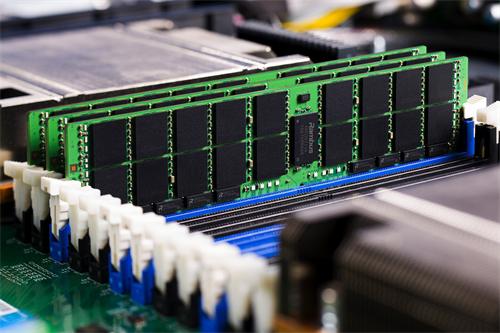
Rack Server Registered DDR Memory Sticks Close-up
Capacity was tied to idle nodes and could not be borrowed by heavily loaded systems.
CXL memory pooling emerged as a potential solution.
Yet the deployment decision proved extraordinarily difficult.
Switches would need replacement. Firmware would need upgrades. Scheduling systems would require redesign. Initial investment costs were substantial.
Even more challenging, the latency penalty introduced by CXL was unacceptable for certain real-time workloads.
The company eventually adopted a hybrid strategy.
CXL was deployed within batch-oriented AI inference clusters, while real-time transaction systems retained traditional memory architectures.
The same data center ended up operating two completely different memory systems.
Part V: Memory Is Repeating the Path CPUs Took
In many ways, memory is beginning to follow the same path CPUs took two decades ago.
During the 1990s and early 2000s, virtually every computing device was chasing the same objective:
Higher clock frequencies.
PCs, servers, workstations, and even early mobile devices all competed along a single dimension.
The industry's central question was simple:
Whose clock speed is higher?
Not:
Which processor architecture should we use?
Then the split began.
Mobile devices discovered that battery life mattered more than peak performance, allowing ARM to rise.
PCs discovered that compatibility and software ecosystems were irreplaceable, preserving x86 dominance.
AI training workloads discovered that parallel throughput mattered more than single-threaded performance, creating space for GPUs, TPUs, NPUs, and other specialized accelerators.
Today, we take it for granted that smartphones, PCs, and AI servers use completely different computing architectures.
That is no longer news.
It is common sense.
Memory may be heading toward the same destination.
The forces that drove CPU fragmentation were different tradeoffs among power consumption, performance, and compatibility.
The forces driving memory fragmentation are different tradeoffs among bandwidth, utilization, and cost.
HBM4 chooses bandwidth and sacrifices scalability.
CXL chooses utilization and sacrifices latency.
DDR6 chooses compatibility and cost efficiency while sacrificing peak performance.
None of these choices is inherently better than the others.
They are simply answers to different questions.
Conclusion: One Question, Three Answers
Ten years ago, enterprises purchasing servers rarely spent much time thinking about which memory architecture to choose.
Memory was little more than a dropdown menu on a configuration sheet.
DDR3 or DDR4.
How much capacity?
What frequency?
Today, that question is beginning to change.
AI teams need to monitor HBM4 production capacity because it may indirectly determine the cost of GPU rentals.
Cloud providers need to evaluate the right timing for CXL deployments because memory pooling could reshape data-center architecture.
Enterprise IT departments need to assess DDR6 platform transition risks because choosing the wrong timing could leave new purchases obsolete sooner than expected.
Ten years from now, choosing a memory architecture may become as important as choosing a CPU architecture today.
Not a technical detail.
A strategic decision.
That may ultimately be the story that HBM4, DDR6, and CXL are telling together:
Memory is no longer a product category.
It is becoming an architectural choice.
Data referenced in this article is current as of June 2026. HBM4 capacity figures are based on public disclosures from Samsung, SK hynix, and TrendForce's April 2026 industry analysis. DDR6 timelines are based on JEDEC standardization documents. CXL adoption and utilization figures are derived from disclosures by CXL Consortium members and Dataintelo's September 2025 market research.
Lucas Reinhardt
Senior Semiconductor Analyst
Lucas Reinhardt is a semiconductor industry analyst focused on advanced manufacturing, memory technologies, and AI infrastructure. His work explores how supply chains, fabrication technologies, and capital investment decisions reshape the global computing landscape. Before becoming an independent analyst, he spent years covering the European semiconductor ecosystem and industrial technology markets.
Recommended for you