The Great Open-Source AI Coding Shake-Up: What the Hype Cycle Missed About the Old Guard

OpenCode and Cline dominate the headlines. But Aider and Continue.dev still own corners of the workflow the newcomers can't reach — and their survival has nothing to do with nostalgia.
By Matteo Ricci
AI Systems & Developer Tools Analyst
Last Updated: June 18, 2026
Reading Time: 12 min read
The Fastest-Growing Projects Are Not Necessarily the Final Winners
In May 2026, Roo Code was archived. During the same month, Google announced that Gemini CLI would be retired on June 18 and transitioned into a closed-source product. Before that, Void Editor had already halted development in mid-2025. The mortality rate of open-source AI coding tools is accelerating.
Yet at the same time, two supposedly “outdated” tools have remained more stable than many of the newcomers.
Aider’s GitHub stars have plateaued at 45,945, while Continue.dev sits at around 31,800. Compared with OpenCode’s 172,198 stars and Cline’s 62,996, neither project belongs to the first tier by headline metrics. But if you ask around in technical communities, a counterintuitive pattern emerges: many experienced developers have no plans to migrate away from them, and many enterprise teams continue to purchase Continue.dev’s enterprise support offerings.
This raises an important question: why haven’t the fastest-growing tools completely replaced the older ones? Why has the market become more fragmented instead of converging around a handful of winners?
If you only look at GitHub stars, Twitter discussions, and funding announcements, it is easy to conclude that Aider and Continue.dev belong to a previous generation. But the data tells only part of the story. SonarSource’s State of Code Developer Survey 2026 found that overall adoption of AI coding tools had reached 84%, with 51% of developers using them daily. Yet as many as 96% of developers do not fully trust AI-generated code, and only 48% can reliably verify the correctness of AI outputs. Meanwhile, JetBrains’ Developer Ecosystem Survey 2026 reported that 82% of developers have not yet deeply integrated AI coding tools into their daily workflows.
Together, these figures reveal an overlooked reality: visibility is not the same as adoption, adoption is not the same as retention, and retention is not the same as workflow dependency. What is happening in the open-source AI coding market is not an elimination tournament. It is an ecosystem divergence.
Part I: The Biggest Misjudgment in the Open-Source AI Coding Market — Treating Stars as Adoption
The developer community has long suffered from a recurring cognitive bias: using GitHub stars, Hacker News discussions, and social media attention as proxies for project success. Yet technology history repeatedly demonstrates that attention and adoption are not the same thing.
The relationship between Docker and Podman is a classic example. Podman never truly replaced Docker, yet it established its own irreplaceable niche in daemonless and rootless container environments. Technology markets rarely converge toward a single winner. More often, they evolve into multiple stable niches.
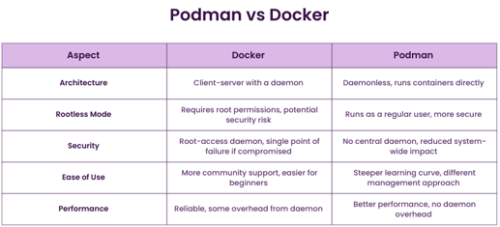
Podman_vs_Docker
What do these examples have in common?
Markets do not necessarily converge around one dominant winner. They stratify into multiple coexisting ecosystems.
AI coding tools are undergoing the same process. OpenCode’s 172,000 stars undoubtedly reflect strong community enthusiasm, but stars themselves do not measure workflow integration depth. Multiple independent evaluations throughout 2026 have shown that OpenCode’s performance on complex tasks can vary significantly depending on workflow design, model configuration, and testing conditions. None of this diminishes OpenCode’s achievements. It simply illustrates a fundamental reality:
Stars measure curiosity. They do not measure reliability.
When developers integrate a tool into production workflows, their evaluation criteria become far more complex than a GitHub metric.
Part II: Why OpenCode and Cline Became the New Stars
The Rise of Agent-First Development
The explosive growth of OpenCode and Cline was not accidental. Together, they represent a broader shift in software development: from code completion to task delegation.
Traditional AI coding tools followed a linear workflow:
Code → Suggestion → Developer Action
The developer remained the decision-making center, while AI acted as an assistant.
OpenCode and Cline restructured the workflow into:
Task → Agent → Result
The developer describes an objective, while the agent plans, executes, tests, and fixes autonomously. The popularity of this model has been reinforced by commercial tools such as Claude Code, which have trained developers to think in terms of delegating multi-step tasks to AI agents.
OpenCode’s core strength comes from its multi-agent orchestration architecture. Planning, coordination, and execution are separated into different layers, allowing complex tasks to be decomposed and handled by specialized agents working together. Combined with broad model compatibility, this design makes OpenCode particularly effective for cross-file refactoring and long-horizon development tasks.
Cline followed a different path: deep integration into VS Code with an end-to-end autonomous workflow. It established a continuous loop of planning, editing, testing, and fixing, and secured $32 million in funding in early 2026. Its greatest advantage lies in its seamless IDE experience. Developers can move from requirements to committed code without ever leaving the editor.
But Agent-First Is Not a Universal Solution
OpenCode and Cline perform exceptionally well on complex tasks, but the agent model introduces its own forms of friction.
OpenCode’s harness-level reformatting bug means that, when paired with certain models, it may modify untouched lines of code indiscriminately. For teams that prioritize code review quality, this can generate large amounts of meaningless diff noise. Cline faces a different challenge: token consumption. In non-trivial multi-file tasks, Cline often requires a 128K context window to operate reliably, while 32K models may exhaust available context or budget before completion. In addition, Cline currently supports only VS Code, which automatically excludes users committed to the JetBrains ecosystem.
These limitations do not diminish the value of Agent-First tools.
They simply demonstrate that Agent-First is a workflow choice, not a universally superior solution.
Part III: Why Aider Has Not Disappeared
Terminal Users Never Wanted an IDE Agent
Aider’s continued survival is perhaps the most misunderstood phenomenon in the open-source AI coding market. Its GitHub star growth has slowed considerably. Its most recent tagged release remains v0.86.0 from August 2025. While daily commits continue, the release cadence is far less aggressive than before. By conventional project-health metrics, Aider should be fading into irrelevance.
Yet reality tells a different story. Aider’s user retention remains remarkably strong, and its audience is unusually well-defined.
Aider’s design philosophy differs fundamentally from OpenCode and Cline. It is not an IDE agent running in a terminal. It is a Git-native pair programming partner.
One of its most distinctive capabilities is Repo Map. Unlike many AI coding tools that rely heavily on vector retrieval, Aider emphasizes understanding the structural organization of a codebase itself. This allows it to work effectively on large repositories while operating within relatively limited context windows and maintaining strong code localization capabilities.
More importantly, Aider is fundamentally Git-native. Every AI-generated edit automatically produces a clean Git commit. The /undo command maps directly to Git reset behavior. The granularity of rollback corresponds exactly to conversational editing steps. For teams that require auditability, this is not merely a feature—it is a compliance prerequisite. OpenCode also supports Git, but its philosophy is that of a terminal application rather than a Git interface. It does not automatically commit after every edit, nor does it map conversations directly to commit history.
Who Is Still Using Aider?
Aider’s user profile is remarkably consistent: backend developers, DevOps engineers, infrastructure maintainers, and open-source project maintainers.
What these users share is an unusually strong emphasis on visibility and control.
Consider a common scenario: SSH access to a production server during an emergency incident. There is no IDE, no graphical interface, and sometimes no stable network connection. In such environments, Aider’s terminal-native design makes it the most natural choice. OpenCode’s TUI can also run in a terminal, but it remains a terminal application that depends on client-server architecture and session attachment. Under unstable network conditions, the experience can deteriorate significantly.
Another scenario involves regulated industries. Fintech companies, healthcare organizations, government contractors, and compliance-sensitive environments often require every code change to be traceable and auditable. Aider’s philosophy of “every edit equals a commit” allows git blame to trace every AI intervention precisely. This is not merely a functional advantage. It is an architectural distinction.
Aider’s Weaknesses
Aider’s limitations are equally clear. It lacks sub-agents and parallel task execution. It cannot decompose complex work in the same way OpenCode’s Sisyphus framework can. Its TUI presents a steep learning curve due to its information density. Poor model selection can result in mismatched editing formats, causing generated outputs to fail during application. Most notably, its release cadence has slowed dramatically, with no new tagged release appearing for nearly a year after v0.86.0.
Yet none of these shortcomings have killed the project.
Because the users it serves often do not care about them.
Backend engineers do not necessarily need parallel sub-agents. They need precise diffs and clean commit histories. DevOps teams do not need visually polished interfaces. They need reliability in SSH environments. Open-source maintainers do not necessarily need constant feature updates. They need stable and auditable code modification workflows.
Aider did not lose to agents. It simply serves a different class of users.
Part IV: Why Continue.dev Remains Surprisingly Resilient
The Enterprise Plugin Nobody Talks About
Continue.dev occupies an even more subtle position than Aider.
With roughly 31,800 GitHub stars, it ranks around seventh among open-source AI coding tools. Its multi-file agent capabilities are widely regarded as less mature than Cline’s in independent evaluations. Its memory footprint, approximately 330 MB, exceeds Cline’s roughly 190 MB. From a feature-comparison perspective, Continue.dev appears to have little reason to survive.
But Continue.dev’s survival has never been primarily about features.
It is about occupying a specific ecosystem niche.
A Standardization Layer for Cross-Editor Teams
Continue.dev is currently the only major open-source AI coding tool that provides deep support for both VS Code and JetBrains environments.
For teams, this matters.
Backend developers can work in IntelliJ IDEA while frontend developers remain in VS Code, yet both groups can share a unified AI experience through centralized configuration. Cline supports only VS Code. OpenCode is fundamentally terminal-based. Neither can fully satisfy the collaboration requirements of cross-editor organizations.
This role as a standardization layer becomes increasingly valuable in enterprise settings. Teams can define shared prompt templates, model-selection policies, and repository-indexing strategies, then distribute them through version control. New developers inherit a consistent AI workflow rather than configuring everything individually.
The Most Mature Approach to Local Model Orchestration
Continue.dev’s native integration with Ollama remains among the most mature in the ecosystem.
In privacy-sensitive sectors such as finance, healthcare, defense, and government, keeping source code inside organizational boundaries is not optional. It is mandatory. Continue.dev offers clear advantages in local model orchestration and repository exploration. Because it relies on prebuilt indexing mechanisms, developers often experience more stable and predictable results when navigating large codebases, rather than depending entirely on real-time retrieval.
This distinction is not fundamentally about speed.
It is about workflow type.
Continue.dev’s prebuilt indexing model makes it particularly effective for exploratory questioning. Developers are trying to understand a codebase before modifying it. Cline’s real-time retrieval model is more suited to task execution. Developers already know what they want to do and need AI to help perform it quickly.
Continue.dev’s Weaknesses
Continue.dev’s weaknesses are equally well-defined.
Its multi-file agent capabilities remain less mature than Cline’s. Complex refactoring tasks often reveal noticeable performance gaps. Its memory consumption can be problematic in resource-constrained environments. Its community remains smaller than those surrounding Cursor and Copilot, limiting the available third-party ecosystem.
Most importantly, Continue.dev often requires team-level configuration decisions. Individual developers may see this as unnecessary complexity. Enterprise teams frequently view it as essential governance.
Continue.dev survives not because it is behind the market, but because enterprise requirements are fundamentally different.
Part V: The Market Is Not Converging — It Is Stratifying by Profession
What is emerging in the open-source AI coding market is not a binary structure of winners and losers.
It is an ecosystem organized around workflows and professional roles.
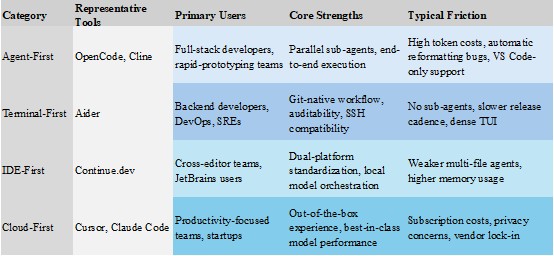
Comparison table of four categories of AI code agent tools
What this table illustrates is not superiority or inferiority among tools.
It highlights differences among workflows.
As AI coding tools mature, professional roles are increasingly shaping their own toolchains around specific operational constraints. The market is not converging toward a single winner. It is evolving into multiple long-term niches.
These needs are not substitutes.
They are often mutually exclusive.
A DevOps engineer who requires Git audit trails will not abandon Aider because OpenCode gained more GitHub stars. A backend developer committed to JetBrains will not migrate to VS Code simply because Cline secured another funding round.
Part VI: The Most Important Competition Over the Next Two Years Will Not Be Between Tools
Competition Is Moving Downward Into the Workflow Layer
One of the most underappreciated trends in the 2026 open-source AI coding market is that the model layer is converging.
Almost every major tool now supports Claude, GPT, Gemini, Qwen, and DeepSeek. Standardization among model providers has made model selection a less significant differentiator. In May 2026, Steel.dev’s SWE-bench Verified analysis even observed that performance differences between models within the same tool could exceed performance differences between tools using the same model.
The evolution resembles the browser market.
Chrome, Edge, Brave, and Arc all share the Chromium engine. The rendering layer is largely identical. Competition occurs at the experience layer—tab management, privacy features, developer tooling, and workflow integration.
AI coding tools are moving toward a similar structure.
Models are becoming shared infrastructure.
Differentiation increasingly occurs through workflow orchestration, context management, agent coordination, and team collaboration.
As a result, the central questions of the next two years will not be whether OpenCode defeats Aider.
Instead, they will be:
- Can Agent-First tools reduce token consumption and improve auditability without sacrificing autonomy?
- Can Terminal-First tools introduce lightweight task decomposition without sacrificing control?
- Can IDE-First tools strengthen multi-file refactoring while preserving cross-platform standardization?
- Can Cloud-First tools address privacy, compliance, and vendor lock-in concerns while maintaining performance advantages?
None of these questions has a universal answer.
Because each corresponds to a different workflow optimization path.
Conclusion: The Real Question Is Not Which Tool Will Win
In AI coding, the most durable tools may not be the ones that do the most.
They may be the ones that remain indispensable to a specific workflow.
Aider’s survival reminds us of something the hype cycle often forgets: in developer tools, being irreplaceable usually lasts longer than being powerful.
References
- JetBrains. Developer Ecosystem Survey 2026. 2026.
- SonarSource. State of Code Developer Survey 2026. 2026.
- BenchLM.ai. SWE-bench Verified Leaderboard. June 2026.
- Gauthier, Paul. Aider Polyglot Benchmark. 2026.
- Karkala, Deepak. OpenCode Sisyphus Framework Documentation. 2026.
- Steel.dev. SWE-bench Verified Leaderboard. May 2026.
- Stanford / Laude Institute. Terminal-Bench 2.0 Results. 2026.
- Digital Applied. SWE-Bench Live Q2 2026 Analysis. 2026.
Matteo Ricci
AI Systems & Developer Tools Analyst
Matteo Ricci covers developer tools, AI-assisted software engineering, and the evolving relationship between automation and human expertise. His writing often examines the gap between technological promises and operational reality.
Recommended for you