The Memory Industry Wants Out

Why DRAM Makers Are Trying to Escape the Boom-and-Bust Cycle
By Lucas Reinhardt
Senior Semiconductor Analyst
Last Updated: May 8, 2026
Reading Time: 8 min read
If an airline went from losing $14 billion to earning $23 billion in profit within just two years, investors would assume something extraordinary had happened—a management overhaul, a radical business model transformation, or a complete reshaping of the industry.
In the memory industry, however, this kind of volatility is considered almost normal.
In 2024, SK Hynix reported a record operating profit of 23 trillion won. Just two years earlier, the company had lost 14 trillion won. What was even more striking was a comment made by the CEO during an earnings conference call:
"We want to evolve from a Memory Company into an AI Solution Company."
Nobody in the room laughed—even though roughly 70% of the company's revenue still came from DRAM. Everyone understood that the statement was not describing reality. It was describing a bet on the future.
For more than two decades, Samsung, SK Hynix, and Micron have repeated the same cycle. One year brings record profits. Two years later comes a massive loss. A few years after that, another record-breaking profit.
The question is: why has this pattern been able to persist for so long?
More importantly, why does the 2024–2026 cycle appear different from the ones that came before it?
Why Memory Is Naturally a Prisoner of Cycles
You do not need an economics textbook to understand the memory cycle. You only need to understand a simple chain reaction:
A cloud provider orders servers → a server manufacturer purchases DRAM → demand surges → prices rise → memory makers expand capacity → a new fab comes online three to five years later → the market has already changed → prices collapse → losses appear → production is cut → supply becomes tight again → prices rise.
The brutal reality of this chain is that by the time new capacity arrives, demand has often moved elsewhere.
A new semiconductor fab typically requires three to five years to build and costs tens of billions of dollars. Memory manufacturers are not simply forecasting the future. They are using today's orders to place a bet on what the market will look like five years from now.
But why are CPU markets not affected by cycles to the same extent?
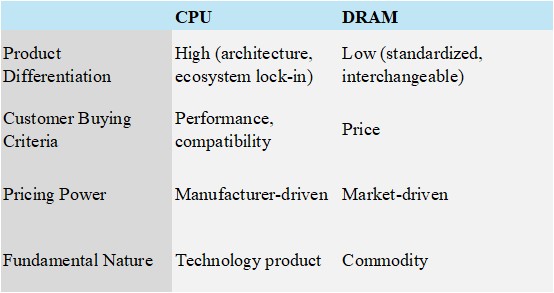
Comparison Table of Commercial Attributes Between CPU and Conventional DRAM
Intel and AMD processors cannot simply be swapped without consequence. Migration costs are high.
Samsung DDR5 and SK Hynix DDR5, on the other hand, are often functionally interchangeable from the perspective of most customers.
When products cannot be meaningfully differentiated, competition inevitably revolves around price and capacity.
This is not a management failure.
It is a structural consequence of how the industry is built.
For Twenty Years, Manufacturers Have Been Fighting the Cycle—and Never Winning
The industry has never been unaware of the problem.
Over the past two decades, manufacturers have tried three major approaches.
Industry consolidation.
Following Elpida's bankruptcy in 2012 and the gradual withdrawal of Toshiba from the DRAM market, the industry consolidated from five major players to three.
Concentration increased, but the cycle remained.
When server demand exploded in 2017–2018, DRAM prices still doubled.
When inventories collapsed in 2022, all three major suppliers still suffered heavy losses.
Long-term contracts.
During the boom years of 2016–2018, Samsung and SK Hynix signed long-term supply agreements with major customers.
The problem was that most of these agreements locked volume but not price.
Pricing continued to fluctuate with market conditions.
When prices surged in 2021–2022, customers complained.
When prices collapsed in 2022–2023, manufacturers still lost money.
Long-term contracts reduced short-term volatility, but they did not change the underlying logic of the cycle.
Capital discipline.
After every downturn, manufacturers announce plans to control capital spending.
Yet after the inventory crisis of 2022, combined capital expenditures among the three major memory makers in 2023 still exceeded 2021 levels.
Why?
Because when competitors are expanding capacity, any company that reduces investment risks losing market share.
Capital discipline is a collective-action problem, and collective-action problems are among the most difficult challenges in oligopolistic industries.
The industry kept trying to change the cycle.
What it never changed was the product itself.
DRAM remained DRAM—standardized, interchangeable, and ultimately forced to compete on price.
Until HBM arrived.
HBM Is the First Memory Product That Is Not Fully Interchangeable
The traditional DRAM market operates under a simple rule:
Customers ask one question.
How much does it cost?
Samsung DDR5, SK Hynix DDR5, and Micron DDR5 are similar enough that most server manufacturers can switch between them with minimal difficulty.
HBM changes that equation.
HBM (High Bandwidth Memory) is not sold as a standalone chip.
It must be integrated with GPUs through advanced packaging technologies such as CoWoS to form a complete computing module.
As a result, customers are no longer purchasing a memory chip.
They are purchasing a system component deeply tied to a specific GPU architecture.
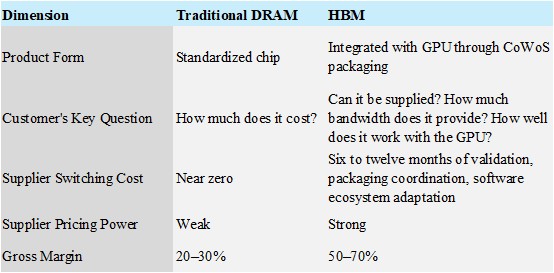
Multi-Dimension Comparison Chart of Traditional DRAM and HBM High Bandwidth Memory
In 2024, HBM accounted for more than 40% of SK Hynix's DRAM revenue. The company's operating margin surged from approximately -20% in 2023 to +52% in 2024.
According to TrendForce's 2025 DRAM and HBM market report, HBM3E gross margins are roughly 30 to 40 percentage points higher than those of conventional DDR5 products.
Yet there is a question that receives surprisingly little attention.
HBM has introduced something memory products historically lacked: characteristics that resemble CPUs and GPUs.
It is no longer fully interchangeable.
The cost of switching suppliers has gone from effectively zero to six months of revalidation and qualification work.
But this shift comes with a price.
According to Omdia's 2025 HBM market tracking report, more than 70% of SK Hynix's HBM shipments are destined for NVIDIA.
This is not necessarily an escape from cyclicality.
It may simply be a transition from a supply-and-demand cycle to a customer-concentration cycle.
From Chasing Market Share to Pursuing Profit Quality
The old logic was straightforward:
Gain market share.
Even if that required price wars.
Even if profitability suffered.
Samsung famously employed an "overwhelm with capacity" strategy during 2016–2017, putting pressure on competitors while also damaging its own profitability.
At the time, the strategy made sense.
Scale created cost advantages.
Cost advantages increased survivability during the next downturn.
That logic is now changing.
Capital discipline.
SK Hynix's revenue grew by more than 100% in 2024, yet capital expenditures increased at a much slower pace.
This is not because the company lacks expansion ambitions.
It is because investments in HBM production generate substantially higher returns than investments in conventional DRAM.
Naturally, resources flow toward higher-value products.
Prioritizing high-value products.
HBM, CXL, and LPDDR5X are receiving priority because they offer differentiation.
Micron's CXL-related revenue represented less than 5% of total DRAM revenue in 2024, yet the category accounted for an increasing share of research and development spending.
Long-term agreements.
Multi-quarter and even multi-year supply agreements with companies such as NVIDIA and Google are becoming increasingly common.
These agreements not only lock in volume but increasingly attempt to establish pricing ranges as well—something that would have been nearly unthinkable in traditional DRAM markets.
Stable margins.
During earnings calls in 2024 and 2025, the words repeatedly emphasized by Samsung, SK Hynix, and Micron were not "market share."
Instead, executives focused on terms such as "profitability," "capital efficiency," and "sustainable margin."
Why are investors becoming increasingly attracted to this model?
TSMC has consistently traded at price-to-earnings multiples roughly two to three times higher than those of memory manufacturers.
The reason is not that TSMC necessarily earns more money.
The reason is that investors ask fundamentally different questions.
For TSMC, the question is:
How much will the company earn next quarter?
For memory manufacturers, the question is:
Will the company be losing money next year?
In capital markets, those are entirely different species of businesses.
Predictability itself carries a valuation premium.
Escaping cyclicality is, at its core, an attempt to earn a higher valuation.
Can the Memory Industry Really Escape the Cycle?
The optimistic case is compelling.
AI demand continues to grow, HBM's share of industry revenue continues to rise, the market remains concentrated among three major suppliers. Coordinated production discipline is easier, long-term contracts are becoming more common, price volatility is being moderated.
But the skeptical view is equally persuasive.
History shows that every period of prosperity eventually attracts new investment.
HBM's extraordinary margins are already encouraging aggressive expansion by Samsung and Micron.
Samsung's HBM market share stood at roughly 10% in 2024, but the company aims to exceed 30% in 2025.
New supply may eventually recreate the cycle.
The only difference may be that the industry moves from a DRAM cycle to an HBM cycle.
Geopolitics is creating new sources of uncertainty as well.
U.S. semiconductor equipment restrictions targeting China have limited upgrade options for Samsung and SK Hynix facilities located in China.
China, meanwhile, has responded with restrictions on certain critical-material exports and has accelerated capacity expansion efforts at companies such as YMTC and CXMT, aiming to raise domestic memory self-sufficiency from approximately 8% to 25%.
These are variables that traditional supply-and-demand models were never designed to explain.
There is also an even more direct question.
What happens if the AI boom ends?
What if NVIDIA slows procurement?
What if AI capital expenditures decline?
What if HBM capacity expansion is completed and supply is no longer constrained?
Would today's narrative of "escaping cyclicality" still hold?
In 2025, spot prices for 8Gb DDR4 rose by roughly 500% within six months, according to TrendForce.
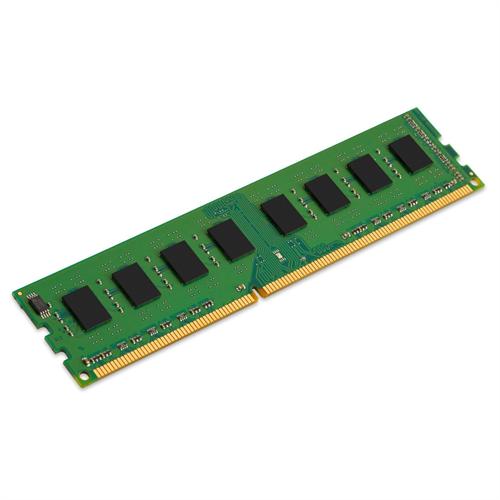
8Gb DDR4
The reason was simple.
The major manufacturers had redirected resources toward HBM, leaving conventional DRAM underinvested.
Ironically, efforts to escape one cycle may have intensified another.
The industry may never fully eliminate cyclicality.
What it may achieve is something more modest:
escaping the extreme boom-and-bust swings that defined the past.
From Expansion to Restraint
For the past twenty years, memory manufacturers pursued larger capacity and greater market share.
Today, an increasing number of companies are pursuing something different:
more stable earnings, higher-value products, and more predictable cash flows.
The significance of the 2024–2026 period may not ultimately be how much prices increased.
Its significance may be that, for the first time, it allowed people to imagine that an industry long regarded as the textbook definition of a commodity business could evolve into something more predictable and more resilient.
Perhaps cycles will never disappear.
But if this transformation succeeds, the next boom and bust may no longer look like the ones the industry has known for decades.
For the last twenty years, the memory industry's greatest strength was its ability to expand capacity.
For the next twenty years, its greatest challenge may be learning how to exercise restraint.
References
1. Morgan Stanley. (2025, December). Memory sector outlook: From cyclical to structural [Industry research report].
2. Micron Technology. (2024). 2024 annual report and investor day materials. https://investors.micron.com
3. Omdia. (2025). HBM market tracker: Q1 2025 [Market research report].
4. Samsung Electronics. (2024). DS division earnings and investor briefing, Q4 2024. https://www.samsung.com/global/ir/
5. SK Hynix. (2024). Q4 2024 earnings call transcript. https://www.skhynix.com/company/eng/ir/
6. TrendForce. (2025). DRAM and HBM market report, Q1 2025 [Industry analysis report].
Lucas Reinhardt
Senior Semiconductor Analyst
Lucas Reinhardt is a semiconductor industry analyst focused on advanced manufacturing, memory technologies, and AI infrastructure. His work explores how supply chains, fabrication technologies, and capital investment decisions reshape the global computing landscape. Before becoming an independent analyst, he spent years covering the European semiconductor ecosystem and industrial technology markets.
Recommended for you