Kubernetes Isn't Dying in 2026—It's Becoming Invisible

The Future of Cloud Deployment May Not Replace Kubernetes. It May Simply Hide It
By Oliver Weber
Cloud Infrastructure Strategist
Last Updated: April 26, 2026
Reading Time: 9 min read
Over the past few years, I've noticed an interesting shift.
Around 2019, technology conferences were filled with discussions about how to "get on board" with cloud-native computing. Many developers highlighted Kubernetes, Helm, and Istio in bold on their resumes, presenting them as core skills and major selling points.
By 2026, however, the landscape feels increasingly fragmented.
I'm seeing more and more younger developers—and even experienced full-stack veterans—who can smoothly publish applications, deploy APIs, and scale databases, yet have never personally written a complete Kubernetes Deployment YAML file.
This does not mean Kubernetes has failed. Quite the opposite. It may have succeeded to the point where it has entered an entirely different phase.
In many scenarios today, the deployment experience has become remarkably simple. Developers push code to GitHub, connect a service such as Cloud Run, Render, or Railway, click "Deploy," and their application goes live. They often have little idea—and even less interest—in whether the underlying infrastructure is running on virtual machines, bare metal, or Kubernetes clusters.
According to the annual survey published by CNCF in early 2026, 82% of container users run Kubernetes in production environments, while 98% of organizations have adopted cloud-native technologies.
If Kubernetes remains the undisputed standard of modern cloud computing, why do so many developers feel as though they are moving away from it?
Part 1: Why Kubernetes Is Becoming Harder to Learn
YAML Is Consuming Simple Projects
Consider how deployment has evolved over time.
In 2012, deploying a simple website often meant uploading files, starting a service, and calling it a day.
In 2026, even a relatively simple project becomes dramatically more complex the moment Kubernetes enters the picture. Developers are confronted with a cascade of concepts:
- Deployment (replica management)
- Service (network connectivity)
- Ingress (external access)
- Secret / ConfigMap (configuration management)
- HPA (horizontal autoscaling)
- Network Policy (zero-trust security)
This is not to suggest these components are unnecessary. For large-scale systems, they are indispensable.
However, for an individual developer who is simply trying to validate an idea, they can represent a significant burden.
Kubernetes' Greatest Cost Is Not Servers—It's Cognitive Load
Server prices continue to decline year after year.
Senior engineering time does not.
Cognitive load is becoming a new form of infrastructure tax.
I once spoke with a startup team in Europe (whose name I cannot disclose due to confidentiality agreements). They had only two developers and three microservices, yet maintained a fully production-grade Kubernetes environment complete with Helm Charts, Prometheus monitoring, and a sophisticated CI/CD pipeline—all in pursuit of architectural sophistication.
Six months later, the outcome was mixed.
The services ran reliably, but the team spent more time maintaining the platform than building the product itself.
Eventually, they reduced their operational burden and migrated much of the infrastructure management to managed serverless container services provided by cloud vendors.
This story is representative of a broader pattern:
Overly complex technology choices often slow down the iteration speed of startups.
Part 2: Are Developers Really Leaving Kubernetes?
The Data Says Kubernetes Is Still Growing
According to CNCF's report, production container usage reached 56% in 2025, while pilot-stage usage fell to 6%.
Organizations are no longer merely experimenting with containers—they are running mission-critical workloads on them.
Cloud providers continue increasing their investments in Kubernetes, and demand for Kubernetes-related roles remains strong in the job market.
But Developer Behavior Is Changing
While adoption numbers continue to rise, developer attitudes are evolving.
Increasingly, people prefer to consume Kubernetes rather than manage Kubernetes.
Within many AI startups funded by Y Combinator, Kubernetes powers the infrastructure from day one. Yet if you ask team members about it, very few have ever opened a Kubernetes Dashboard.
To them, Kubernetes is simply a scheduler running quietly in the background.
The Kubernetes Paradox
Two trends are happening simultaneously:
- More applications than ever are running on Kubernetes.
Industry data shows that 66% of organizations use Kubernetes to host generative AI workloads.
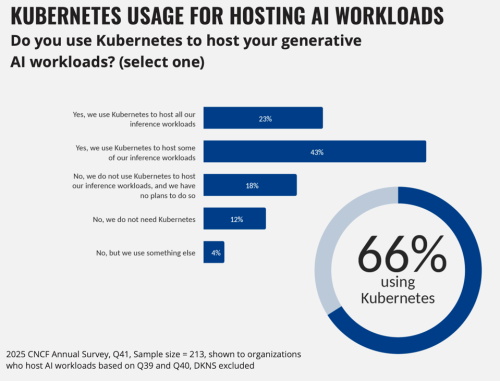
Kubernetes AI Usage – CNCF
- Fewer developers are directly operating Kubernetes.
Many AI engineers care deeply about API response times but have little interest in orchestration details.
These two realities are not contradictory.
They are happening at the same time.
Part 3: Trend One — Platform Engineering Is Hiding Kubernetes
In the past, DevOps culture often expected development teams to both write application code and manage infrastructure YAML.
That model is evolving into Platform Engineering.
Platform teams increasingly handle Kubernetes' operational complexity, including version upgrades, security patches, network policies, and infrastructure governance.
They build what is commonly called an Internal Developer Platform (IDP).
What Developers See
In a mature platform engineering environment, developers may interact only with a simple internal portal or command-line tool.
> app create my-service
> app deploy
> app rollback
What Developers Don't See
Behind those commands lies a vast amount of hidden complexity:
- YAML generation
- Helm dependency management
- Service mesh configuration
- RBAC permission systems
The changing job market reflects this shift.
Many large organizations are now hiring Platform Engineers rather than purely Kubernetes Engineers.
The emphasis is moving away from "writing YAML" and toward "building platforms."
Part 4: Trend Two — Serverless Is Redefining Deployment
The First Instinct of a New Generation Has Changed
The traditional mindset was:
"First, build servers."
The modern mindset is increasingly:
"First, deploy code."
One independent developer building a fitness-tracking SaaS originally assumed Kubernetes would be a necessary part of the journey.
By late 2025, however, he had completely migrated to a combination of Fly.io and Supabase.
His reasoning was simple:
With serverless architecture, he was not purchasing computing power.
He was purchasing less operational work.
He no longer needed to worry about control plane failures, etcd backups, or cluster administration.
The time saved could be invested directly into marketing, customer acquisition, and product development.
The Backlash Against Premature Architecture
To be clear, serverless is not the right solution for everyone.
However, the consequences of overengineering can be even more damaging.
A financial technology startup in Australia, consisting of roughly five team members, decided to deploy everything on Amazon EKS from day one in pursuit of a modern architecture.
Six months later, they had not yet achieved product-market fit.
What they had achieved instead was a growing infrastructure bill and a collection of difficult-to-debug networking problems.
Ultimately, they simplified their architecture and returned to a much more straightforward setup—essentially a monolith running on cloud virtual machines.
This situation is surprisingly common.
The product has not yet found users, but the architecture already resembles that of a Fortune 500 company.
The outcome was mixed.
Kubernetes provided stability.
It also accelerated spending.
Part 5: Trend Three — AI Is Becoming the New Infrastructure Interface
Kubernetes Solved the Server Problem. AI Is Starting to Solve the Kubernetes Problem.
In the past, troubleshooting required memorizing a long list of commands:
- kubectl describe
- kubectl logs
- kubectl exec
In the future, the primary interface may be conversation.
In early 2026, Asergo published a case study describing how it was building a new platform based on the BEAM ecosystem to support large-scale Kubernetes hosting.
More broadly, tools such as Kubernetes GPT plugins have become increasingly common inside VS Code.
A developer may simply ask:
"Why has the order service suddenly become slower?"
An AI agent can then automatically:
- Query Prometheus metrics
- Correlate logs and stack traces
- Analyze bottlenecks
- Suggest likely root causes
The issue might be CPU throttling.
It might be a leaking database connection pool.
The investigation increasingly becomes automated.
Infrastructure Is Becoming Conversational
The future of infrastructure management may be described as Declarative Natural Language.
In the past, value came from memorizing commands.
In the future, value may come from understanding how to ask the right questions—and how to verify whether AI-generated configurations are actually safe.
A vulnerability disclosed by Wiz in 2026 involving Ingress-NGINX, which could potentially allow cluster compromise, serves as an important reminder:
AI-generated YAML can introduce significant security risks if it is not properly reviewed.
AI Will Not Replace Operations Teams
But it may replace repetitive operational work.
Examples include:
- Log inspection
- Configuration debugging
- Resource bottleneck analysis
CNCF survey data supports this trend.
Cloud-native observability platforms such as OpenTelemetry, which has reached 49% production adoption, are laying the foundation for the next generation of AIOps systems.
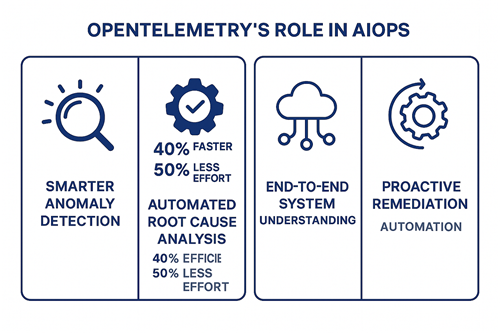
OpenTelemetry’s role in AIOps
Part 6: The Biggest Winner May Not Be a Replacement
Many people ask:
Who will replace Kubernetes?
History suggests that replacement rarely comes from a direct competitor.
More often, it comes from an abstraction layer.
Analogy 1: TCP/IP
Few people discuss the details of the TCP/IP stack.
Yet everyone uses it every day.
Analogy 2: The Linux Kernel
A large percentage of smart devices run Linux.
Most users have no idea it is there.
Analogy 3: Database Engines
Backend developers depend on MySQL and PostgreSQL daily.
Very few spend time studying the internals of InnoDB.
Kubernetes appears to be entering the same stage.
It is no longer the technology that developers proudly showcase as the centerpiece of their resumes.
Instead, it is becoming a commodity infrastructure layer—something as fundamental and invisible as a CPU.
Part 7: What Should Ordinary Developers Do?
If You Are a Beginner
Do not make your goal:
"Learn Kubernetes."
Instead, make your goal:
"Learn how applications are deployed."
Understanding containers, networking, scalability, and distributed systems fundamentals is far more valuable than memorizing kubectl commands.
If You Are an Indie Developer
Validate the product first. Optimize infrastructure later.
Do not adopt Kubernetes simply for practice or prestige.
In 2026, serverless container platforms offered by major cloud providers are often capable of supporting products all the way to the million-user scale.
If You Are a Backend Developer
Understand Kubernetes concepts such as:
- Affinity
- Resource quotas
- Scheduling
- Scaling
But do not become obsessed with manually writing every YAML file.
Future value increasingly comes from:
- System design
- Automation thinking
- Effective collaboration with AI
If You Are a DevOps or SRE Engineer
Pay close attention to:
- Platform Engineering
- AI-Assisted Operations
As major industry trends in 2026 demonstrate, the growing importance of AI workloads, edge computing, and stateful services is changing the rules of the game.
If your expertise remains focused solely on manually crafting YAML files, it may be time to move toward higher-level platform design, reliability engineering, or data infrastructure.
Conclusion
Kubernetes has not disappeared.
It is experiencing the fate common to many mature technologies:
It is becoming part of the background.
When a technology truly becomes infrastructure, people stop talking about it.
According to analysis conducted by HyperFRAME Research for CNCF, the greatest obstacle to Kubernetes growth in 2026 is no longer technical debt.
It is cultural friction.
That suggests the technology itself is largely ready.
What remains is the process of human adaptation.
Over the next few years, we may witness a world where:
The vast majority of cloud-native applications run on Kubernetes, yet the vast majority of developers never open a Kubernetes Dashboard.
If that future arrives, it may not represent Kubernetes' failure.
It may represent its greatest success.
References
1. Cloud Native Computing Foundation. (2026). CNCF annual survey 2025: Cloud native adoption continues to rise. https://www.cncf.io/reports/cncf-annual-survey-2025/
2. HyperFRAME Research. (2026). The state of Kubernetes friction points: Platform engineering as the cultural remedy (Report No. HFR-2026-04). HyperFRAME Media.
3. Robbins, M. (2026, March 15). How conversational AI is reshaping infrastructure management. Asergo Blog. https://asergo.io/blog/conversational-ai-infrastructure/
4. Wiz Research Team. (2026, January 22). IngressNightmare: Critical NGINX Ingress controller vulnerabilities expose nearly 43% of all cloud clusters. Wiz Blog. https://www.wiz.io/blog/ingressnightmare-nginx-ingress-controller-vulnerabilities
Oliver Weber
Cloud Infrastructure Strategist
Oliver Weber writes about cloud infrastructure, platform engineering, and large-scale distributed systems. He is particularly interested in how infrastructure becomes invisible over time, turning once-complex technologies into foundational utilities that developers rarely think about.
Recommended for you